
For Environment, Democracy and Livelihoods
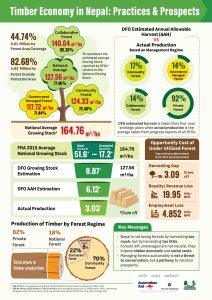
The infographic “Timber Economy in Nepal: Practices and Prospects” has been developed using data compiled from the five-year strategic plans of all 84 Division Forest Offices (DFOs) in Nepal. A comparison with the national growing stock estimated by the Forest Resource Assessment (FRA) 2015 for forests outside protected areas (164.76 m³/ha) shows that the average growing stock reported in DFO strategic plans is only 127.56 m³/ha, representing 77.46% of the FRA estimate. Similarly, DFOs have estimated the growing stock of Government Managed Forests, Community Forests, and Collaborative Forests at 117.72 m³/ha (71.44%), 124.33 m³/ha (75.46%), and 140.64 m³/ha (85.36%), respectively.
Based on the FRA-estimated growing stock, forests outside protected areas have the potential to produce up to 51.6 crore cubic feet of timber under an ideal scenario. Even under a more conservative and accepted scenario that fully considers sustainability of production, timber production could still reach 17.2 crore cubic feet. However, largely due to factors associated with the political economy of the forestry sector, the lower growing stock estimates used by DFOs reduce this potential to 8.87 crore cubic feet. Furthermore, DFOs have estimated the Annual Allowable Harvest (AAH) at only 6.12 crore cubic feet.
Actual production remains substantially below the estimated AAH. Community Forests, Government Managed Forests, and Collaborative Forests produce only 17%, 14%, and 14% of their estimated AAH, respectively. In contrast, production from the Private Forests have achieved 92% of their estimated AAH. As a result, annual timber production stands at just 3.03 crore cubic feet, of which 82% is supplied by forests on private land.
Under the current scenario, the underutilization of forest resources results in an annual harvesting gap of 3.09 crore cubic feet. This translates into an estimated opportunity cost of NPR 19.95 arba in lost government royalty and revenue, along with NPR 4.852 arba in forgone employment opportunities.
Key messages: