
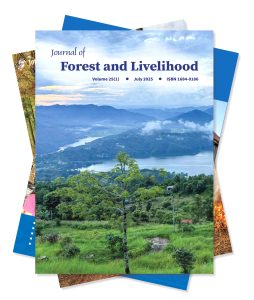
About Journal of Forest and Livelihood (JFL)
Journal of Forest and Livelihood is a peer-reviewed journal that documents and disseminates the insights, lessons, and innovations taking place in socio-cultural, political, and economic aspects of environmental governance and rural livelihoods in Nepal. The journal aims to inform the environmental policy process by facilitating dialogue among politicians, professionals, activists, researchers, and policymakers. In doing so, it documents and disseminates the insights, lessons, and innovations taking place in socio‐cultural, political, and economic aspects of environmental governance and rural livelihoods in Nepal. Original scientific papers, short communications, and review articles are published in the journal. The authors are fully responsible for the originality of the paper and formal correctness and should ensure that the paper has not been published previously.
Type of contribution: Contributors may consider two options:
a) Long articles (up to 7000 words), or should not exceed 14 pages, including tables, figures, references, and abstracts;
b) Review articles (up to 6000 words) or should not exceed 12 pages, including tables, figures, references, and abstracts;
c) Opinions or short technical communications (up to 4000 words) or six printed pages.
Specify the type of your contribution while submitting the article.
Abstract and key words
An abstract is a short summary of the whole paper. Authors are required to include an abstract not exceeding 250 words and 5 keywords. It should describe all essential facts of a scientific paper. Keywords must be included and should not be the repeated words that are included in the title of the papers. Key words should be taken from the main body of the paper. The abstract is an important part of the paper and cited in world databases.
Introduction
Introduction can outline the main reasons why the research was conducted; describe a brief review of literature consisting of refereed periodicals, journals and books, and the goal of the authors.
Language: Articles should be submitted in English (British), bear in mind that there should be uniformity in the language used.
Mode of submission
Articles should be submitted in electronic form in the e‐mail address provided.
Formatting: Standard size of paper (A4 format), type size 12 font in Times New Roman, 2.5 cm margins on each edge of the page. The heading levels should be properly identified.
Author details: give full name, organizational affiliation and position, and email address. In the case of multiple authors, identify the corresponding author.
AI and Plagiarism: The use of generative AI and AI-assisted technologies in scientific writing must be declared by adding a statement at the end of the manuscript upon initial submission.
All submitted manuscripts, including articles, commentaries, and opinions, will be subjected to a rigorous plagiarism screening process. Any submission found to contain plagiarised content will be rejected without further consideration. Authors are responsible for ensuring that their work is original and that all sources are properly acknowledged through appropriate citations.
Please note that simultaneous submission to multiple journals is strictly prohibited. Manuscripts submitted to this journal must not have been previously published or be under review elsewhere. Adherence to these guidelines is essential to uphold the integrity, authenticity, and academic standards of the publication.
References: All publications cited in the text must be included in a reference list at the end of the document. Authors are strongly advised to follow standard scientific referencing conventions and format all citations and references according to the APA 7th edition (American Psychological Association) guidelines.
Remuneration: No remuneration is available for the published articles.
Timing of publication: While we adhere to the planned timing, the exact date of publication depends on the availability of adequate and appropriate contributions in time, standard of writing and time availability of editors.
Right to accept or reject: The Editorial board reserves the right to either accept or reject the submitted articles.
Editing: Articles may be edited for clarity. Edited manuscript will be sent back to the author (s) for approval.