
For Environment, Democracy and Livelihoods
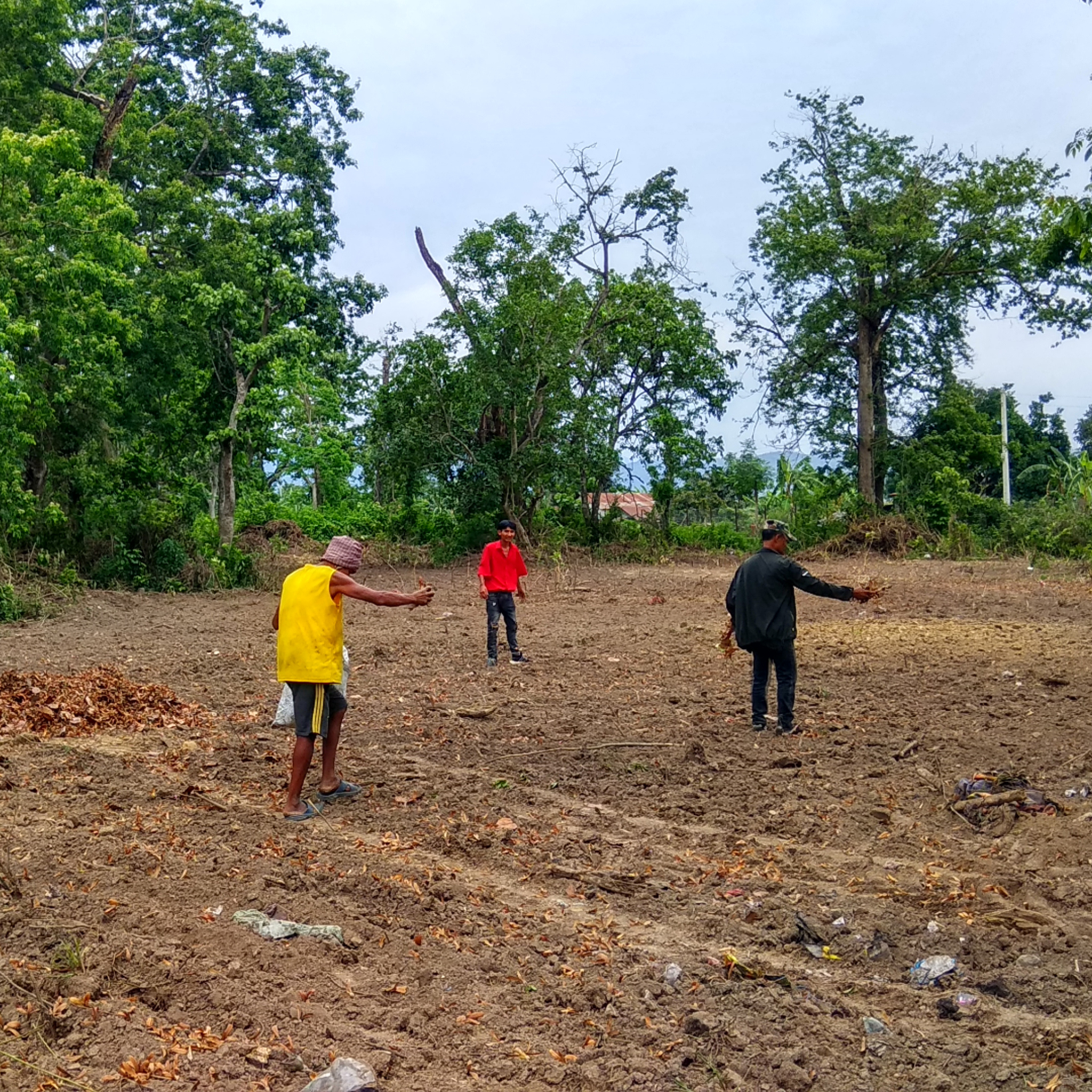
The Barandabhar biological forest/corridor is unique in terms of its rich biodiversity, and connects Chitwan National Park in the south to the Mahabharat Hill Range in the north. In the recent years, the biological corridor has been affected by infestation of invasive alien plant species like Mikania micrantha, Lantana camara and Chromolaena odorata among others. While efforts have been in place to address the issue in the past, the interventions did not take into consideration couple of aspects like natural regeneration, season for invasive plant removal, and targeted species for removal among others. With an aim to mitigate the problem, ForestAction Nepal has been working with the community forest user groups to restore the degraded forest and conserve biodiversity through site level demonstration, building capacity of the forest user groups, and provide feedback for future efforts on policy reform in forest restoration. The initiative is supported through IKI small grant.
Here are some of the key achievements of the intervention:
■ Selective invasive plant species were completely uprooted or slashed through use of local technologies like sickle, spade, kutto, kodalo. Over 700 Metric tonnes of invasive plant species have been collected restoring 110 hectares of forest land. It was mostly the forest user groups engaged in the work that took 800 man-days involving over 120 local people, mainly women.
■ With an aim to promote natural regeneration, protection of native species was prioritized. So far, over 24000 native seedlings have been protected, including Sal, Khasreto, Kadam, Padke, Sitalchini, Kamare, Sindure, Asna, Rajbrikshya, Kadam, Simal.
■ Training was provided to 94 members from three community forests.A total of 60 quintal of compost manure prepared out of the invasive plants. The composts are being used in their farms.
■ A biodiversity assessment and profiling of Barandabhar corridor is being undertaken. Floristic survey has reported a total 347 species of flowing plants, faunal survey listed 47 species of amphibians and reptiles, 7 species of the reptiles and amphibians that are listed in IUCN Red list (1 Endangered, 2 Vulnerable, and 4 Near Threatened) and 7 listed in CITES (1 Appendix I and 6 Appendix II), two of which are endemic to Nepal has been found.
■ One amphibian species which is expected to be new to science and 2 species of plants that might be new to Nepal has been found (yet to be verified).
■ Communication and dissemination of the work, along with preparation and publishing of training materials.


