

Nepal is often known for its forward-looking climate policies, along with strong advocacy of climate finance agenda in the global forums, pitching for international climate finances to build community resilience and enhance adaptive capacity. Besides being one of the top 10 vulnerable countries in the world, it is also among the first countries in the world to institutionalise climate budget tagging (CBT) in 2012, a system designed to classify and track public expenditure on climate change. The Ministry of Finance (MoF) has been leading the implementation of CBT. The tagging system is applied at the project level rather than at the activity level. Under the system, projects are categorised based on their contribution to climate action as Direct, Indirect, or Neutral, and further classified into areas such as Adaptation, Mitigation, or mixed benefits. To strengthen climate finance management and tracking, the MoF approved the Climate Change Financing Framework (CCFF) in 2017.
Nepal’s Climate Change Policy, the National Adaptation Plan (NAP) and the Nationally Determined Contributions (NDCs) have reinforced commitments to climate resilience and low-carbon development. The government has also promoted Local Adaptation Plans of Action (LAPA) framework to ensure bottom-up planning and vows to disburse 80% of the climate finance at the local level.
On paper, the system and frameworks are impressive and aligned with the best global practices and grounded in strong institutional thinking.
However, the ground reality tells a different story.
A system that exists, but is barely used
Across municipalities, consultations with local government officials revealed a consistent pattern: climate budget tagging exists, but it is rarely used in practice. In many cases, officials are either unaware of the system or have not received the training needed to apply effectively. Governments have made limited institutional efforts to embed CBT within local planning and budgeting processes.
This doesn’t mean climate related initiatives are not progressing. Municipalities regularly allocate budgets to sectors such as energy, agriculture, forestry, and natural resources management. However, these expenditures are not systematically tagged, tracked, or reported as climate finance. As a result, a substantial portion of climate-relevant investment remains unrecognised within formal systems.
A closure look at municipal budgets illustrates this gap. In Devchuli and Gaidakot municipalities, a preliminary analysis using the CBT framework suggests that approximately 10-15% of annual budget could be classified as climate relevant. Yet, in the absence of formal tagging, these figures remain unofficial and invisible in reporting.
Local officials themselves acknowledge this gap. One municipal officer noted, “The activities are happening, we now realised that they are climate relevant, but they are not recorded as climate actions/interventions so far.” He further added, “We prepare annual plans through participatory approach, but to my knowledge, climate tagging has not been used.” Similarly, planning officials emphasised that integrating CBT is possible, but only if technical training is provided before the planning process begins.
Why tracking matters?
At first glance, this might look like a technical issue. But it has broader implications.
Without proper tracking:
– It becomes difficult to assess how much Nepal is investing in climate action
– The effectiveness of those investments remains unclear
– Opportunities to attract additional climate finances, especially from international sources, are reduced
Global climate finance is increasingly tied to transparency, performance and accountability. Funds like Green Climate Fund (GCF) and Adaptation Fund expect vulnerable countries like Nepal not just make commitment but demonstrate measurable outcomes. If Nepal cannot clearly show where and how climate finance is being used, it risks losing those opportunities.
The question of equity: Who benefits from climate finance?
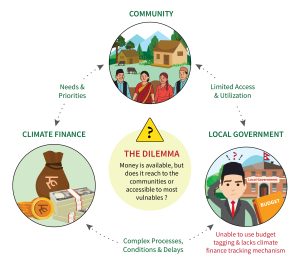
Nepal’s climate policies consistently emphasise support for the most vulnerable groups i.e., poor households, women, marginalised communities, and those living in climate sensitive areas. But when spending is not clearly tracked, it becomes difficult to ensure that these groups are being prioritised and benefitted. The question is; Is climate finance accessible to the most vulnerable ones? In current scenario, there is high chance that better connected or more accessible communities may receive more resources, while vulnerable populations in remove areas risk being overlooked. Without a clear system to monitor and prioritise funding, equity can easily become an aspiration rather than a reality. The absence of implementing climate budget tagging during the planning process further reinforces this imbalance.
A growing dilemma for the future
As global climate funds increasingly emphasise results-based financing, transparency, and accountability, Nepal’s ability to access and utilise these resources will depend on its capacity to track and demonstrate climate expenditures and outcomes.
Here lies the dilemma, Nepal has already developed policy and institutional framework to track climate finance, which are hardly practiced. At times when global climate finance is expanding, Nepal could struggle to access it – not because the money is not available, but because mechanism to track and demonstrate its use are not fully operational. If local governments cannot show how climate investments are being made and what impact they are having, it becomes harder to justify and tap available funding opportunities, particularly from international sources.
Bridging and closing the gap
If climate finance is to reach those who need it most, the focus must shift from introducing tools to making them work in practice. Otherwise, the equitable climate finance will remain a promise, rather than a reality.
Nepal has already taken a step by designing a robust policy framework for climate finance. The next challenge is ensuring that it works in everyday practice. Ultimately, climate finance is not just about policies or budgets – it’s about whether support reaches the communities that need it most. If systems remain underused, the promise of climate finance will stay on paper. But if they are put into practice, they can become a powerful tool for building resilience where it matters most.
The solution lies not in creating new policies, regulations and institutions, but in putting them into practice. Priorities should be given to;
– Raise awareness and building technical capacity among local government officials on climate budget tagging and climate-responsive planning
– Integrate CBT into municipal budgeting systems and guidelines, ensuring it becomes a part of routine practice
– Strengthen monitoring and reporting systems to improve transparency and accountability
____
This blog is based on reflection from municipal level consultation workshops under Climate Action Financing Through Women and Social Enterprises (CaFiN) project funded by IDRC through CPI.