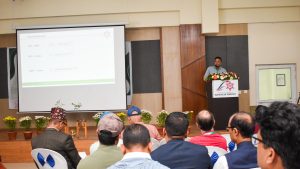
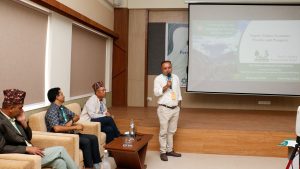
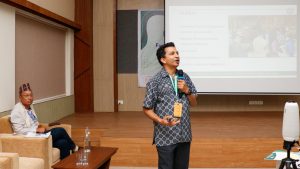
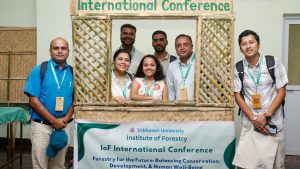
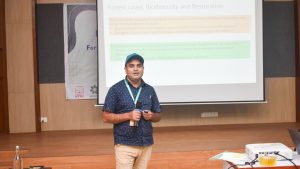
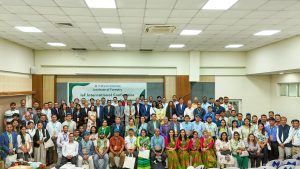
The Institute of Forestry (IoF), Tribhuvan University (TU), Nepal, organised the IoF International Conference from 14–16 August 2026 under the theme “Forestry for the Future: Balancing Conservation, Development, and Human Well-Being.”
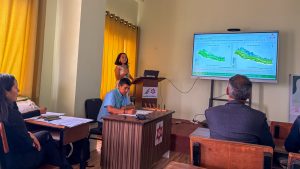
ForestAction Nepal had the opportunity to present its research during the plenary session titled “Unlocking Nepal’s Timber Economy,” which explored the foregone and untapped economic potential of Nepal’s forestry sector. The research presented during the session focused on the current status, production potential, and market demand of timber across the country. The findings highlighted the significant gap between Nepal’s available timber potential and its actual production, emphasising the opportunity costs associated with underutilisation in terms of revenue generation and employment opportunities.
Following up the session, another presentation by fellow researcher at ForestAction Nepal was shared on “The political economy of timber in Nepal,” exploring the institutional and political factors that influence timber harvesting and forest management. His presentation examined the roles and power dynamics of key actors, persistent institutional stagnation, competing interests, and political influences affecting timber production. It further examined how existing policies, regulatory frameworks, and operational practices influence Nepal’s timber production potential.
Together, the presentations contributed to a broader discussion on how Nepal can unlock the economic potential of its forestry sector while maintaining sustainable forest management, strengthening governance, generating employment, and promoting the well-being of forest-dependent communities.
Beyond the plenary, ForestAction Nepal researchers also presented their work across the conference’s parallel sessions, contributing to discussions on forest restoration, forest fire management, and forest biometrics.
Research presented under the session, Forest Biometrics and Quantitative Forest Assessment, explored estimating trespassed volume of Sal (Shorea robusta Gaertn.) tree from the stump diameter in Eastern Nepal, offered practical, field-based method for quantifying timber loss from illegal felling, contributing to more accurate assessment of unauthorised harvesting and strengthening forest monitoring efforts in Sal-dominant forests.
Similarly, under the Forest Fire & Post-Fire Recovery session, research on forest fire management assessed the labour costs and risk perceptions associated with fire management activities, highlighting the limitations of relying solely on voluntary community labour and making the case for incentive-based mechanisms that better recognise the risks borne by community members engaged in fire prevention and control.
One of the researcher also presented on Reimagining Forests: Restoration and Social–Ecological Systems, arguing for restoration success to be measured beyond simple forest cover metrics, examining how ecological and social outcomes vary depending on the management regime in place, and offering evidence to inform more nuanced, outcome-based approaches to assessing restoration effectiveness in Nepal.
Similarly, Dr. Lila Nath Sharma contributed under the session on Forest Restoration & Regeneration, presenting on “Reframing Nepal’s forest restoration from cover to biodiversity for resilient landscape.” His presentation argued that cover-centric restoration targets can mask underlying ecological degradation and called for restoration indicators that better capture biodiversity gains and long-term landscape resilience. Dr. Sharma also chaired a parallel session on Climate-Smart Tree-Based Systems for Resilient Landscapes.
Through these contributions, ForestAction Nepal brought evidence-based perspectives and findings to discuss on sustainable and resilient forest management, stregthening links between research, policy and practice. ForestAction Nepal expresses its gratitude to Institute of Forestry, Tribhuvan University for the valuable organisation of such a timely event.
Old growth forest along with Pokhari and temple in Satyawati religious forest in Palpa district
Background
Deep inside the forest, under the canopy of old growth trees, we can feel the whispering winds of ancient forests and hear the soothing forest acoustics. Beneath our feet, tangled roots of ancient trees in long-established ecosystem communicate through a massive network of fungal hyphae. The tree trunk composed of hundreds of concentric rings inscribe a history of details of climate spanning centuries. Each ring tells the story of how the land was wounded, how it healed, and how life responded to changing climate and human perturbation. Unfortunately, such old growth forests are rarely found in the domesticated landscape we live today. Here we tell a story where old growth trees and forests are preserved and the practice that protects these heritages.
Today, as we stand at the crossroads of environmental degradation and ecological restoration, it’s time to contemplate on memories of the land and its forests that have shaped our cultures and lives for centuries. At the same time, we also need to retrospect how humanity has destroyed, altered and degraded the shared home of millions of species.
Reflecting on the past, there was a serious concern about widespread environmental degradation in the southern flanks of the Himalayas during 1970s. Erik Eckholm’s narratives in his book “Losing Ground” laid the foundation for the ‘Theory of Himalayan Degradation’. He attributed unsustainable agricultural practices, poverty and growing population in the hills as cause of deforestation, soil erosion, landslide and flood.
Later, scholars scrutinized the theory and presented counter narratives and argued that the theory oversimplified the complex socio-ecological problems. TBS Mahat through in-depth cases in Sindhupalchowk highlighted that deforestation in the middle hills of Nepal was not a sudden phenomenon of 1950s, but a long-standing process dating back to the late 18th century. Scholars presented that environmental degradation including deforestation was the result of government policies prioritizing agricultural land and promoting unsustainable land use for revenue generation.
Amidst the debate on widespread of deforestation and forest degradation there also remained a spark of hope; like seeds of life in the ashes. Scholars have presented cases where communities have conserved forests and natural heritages through social norms, belief systems and cultural practices. Sacred groves, ancient trees, communal spaces like Chautaris (a traditional resting place), and water sources continue to flourish. These spaces, nurtured by centuries old traditions, stand as a beacon of hope for restoration in the era of environmental crises.
Sacred groves: a place of worship or conservation?
An old growth forest surrounds the Rambhadevi temple, a popular shrine in Palpa district. While the surrounding landscape has lost its old growth trees, these remain protected around the temple. Generally referred as Rambhapani, this sacred site is closely linked to water protection. According to locals, Lord Ram is believed to have created a spring just above the temple during his visit. This belief has played a role in forest protection. Additionally, historical records show that the Rana rulers issued a Lalmohar (an order) in 1918 BS to protect the forest, ensuring its survival for generations. Today, Rambhadevi Forest is home to 35 native tree species, including massive old-growth trees like Kaulo and Saur, old Bet liana stretching over 100 meters, and diverse wildlife, including notable abundance of squirrels.
A small island of trees stands in the crop field and settlement near the bank of Narayani River in Gaindakot. This grove called Mahadevthan was protected by the Tharu people as a place for their deity. It survived the wave of deforestation in Terai during the 1950s to 1970s. This grove, less than two ha, is home to 38 native species of trees including several old-growth individuals, most of which have naturally regenerated. Similarly, in a nearby locality, a sacred grove called Devithan was observed to host a remarkable 20-meter-tall Bakhre ghans (Streblus asper) tree with over 60 cm diameter at breast height. No such large tree of this species is found in the landscape.
Small grove that survived the wave of deforestation in Terai Nepal (Mahadevthan in Gaindakot 13)
Our observation in Pokharichhap village, Ghiring, Tanahun, showed that tall Simal trees serve as critical nesting and resting sites for white-rumped vultures. The grove itself is considered sacred, with several thans (places of worship) established within it, reinforcing its role in conservation through cultural reverence.
In Chaubas of Kavre one can commonly see pine forests which were established in the degraded areas. In the mosaics of pine forest and farm, there exists a distinct grove of broad-leaved trees. Actually, the grove was a sacred site known as Kali Devi or Devithan. The grove has old growth trees of Aanp, Mauwa, Chilaune, Banj, Phalant and others. One of the local female residing there explained that people believed cutting trees or polluting the Devithan area will displease the goddess. Not only in Chaubas, but also across the country, people worship and protect trees to keep bad spirit away.
These sacred sites not only conserve ancient trees but also provide refuge and protect biodiversity during times of environmental distress. It became clear that local communities conserve forests through a mix of belief systems, cultural practices and a sense of environmental responsibility. Though not always framed in terms of biodiversity, their efforts are crucial for forest conservation. Cases of biodiversity of various sacred groves clearly show that they are not only a place for worship but also have high conservation values as both of them co-exist.
Satyawati religious forest with an old growth tree of Tooni
What legacy do we leave for future generations?
While walking alongside planted pine forest at Chaubas, we stopped at an abandoned Chautari, which had an old growth tree of Lankuri, measuring 98 cm diameter at breast height. No such big trees were seen in the landscape. We did not see Lankuri trees in the pine forest either, that was planted four decades ago.
Then, we came across Pale Ban, an ancient forest protected by the local community for generations. Strict regulations prevent tree cutting, protecting and conserving native species like Sano Aarpate, Kafal, Jhigane, Gurans, and Lapsi. The forest is protected as it shelters Padhera, a natural spring, and locals have long known that cutting trees near water sources causes depletion of natural springs. In the landscape dominated by pine plantations mostly coming all the way from Mexico, these old native trees remain conserved due to cultural beliefs and social rules.
The legacy we leave, as shown by the Chautari and pale ban in Chaubas, the groves in Gaindakot, Rambhadevi and Satyawati is our commitment to conserve both nature and culture. This imparts a powerful reminder that the decisions and contributions we make today to conserve natural environment are the legacy we leave for tomorrow.
Gods and goddesses dwell where trees thrive and waters flow
Near Pokharichap village in Ghiring, Tanahun, there is a pandhero (water spring) from where people used to fetch drinking water. While tap water is now available in the village, four springs are designated for human use, and two remain reserved for livestock. Yogendra Bikram Poudel, who has expertise on differentiating plant species, walked around the spring to count and identify trees. He recorded nearly 50 individual trees from 30 different species around the water spring, including several tall and old tree. Among them, Dhalne Katus and Simal stand out, with some trees exceeding 100 cm in diameter-larger than those found in the nearby community forest. The grove also harbors rare species of trees like Gai Simal, adding to the area’s biodiversity value.
Rich grove along with Pandhero (Kuwa) in Ghiring
It is believed that Satyawati Bajai, resides in the Satyawati Religious Forest in Palpa. For generations, the local Magar community driven by belief in the supernatural power of bajai has protected the area, ensuring its conservation. The forest is home to around 75 species of trees. Sadan, Chilaune, Tooni, and Mauwa trees dominate the forest. The forest hosts vulnerable species listed on the IUCN Red List, such as Satisal, along with medicinal plants like Ayero, Harro, Barro, and Hadchur. It also hosts rare species like Kukhure Kath and sacred plants such as Belpatra and Rajbriskha. The forest is home to hundreds of birds like Jureli, Nyauli, and Kaliz, and animals such as Mriga and Ban Biralo.
Beside the temple of bajai lies Satyawati Lake which is more than just a water body. Pilgrims circle the lake three times shouting their wishes to a bajai believed to be hard of hearing but immensely powerful. Rituals like taking a holy bath and placing linga (Bamboo, Sal stems) in the lake symbolize devotion, with a belief tied to the water; placing more linga, makes the lake grow, strengthening the goddess and fulfilling wishes. Scientifically, displaced water creates the illusion of lake growing, linking tradition with nature. This belief draws thousands of devotees, helping protect the lake and its surrounding forest.
As we ventured further in Satyawati, we discovered Dyangtung Kuwa, a water source surrounded by ancient trees of Khalluk and Chilaune. In fact, there are more than six such kuwas scattered across the religious and community forests nearby. Isn’t it remarkable how belief in bajai helped preserve forest and the vital water resources, ensuring they don’t vanish?
When roots weaken and guardians fall
Sacred groves and all landscape legacies are facing numerous threats that compromise their bo th cultural and ecological integrity. Mismanagement of financial resources coupled with misguided concept about ‘development’ have hampered conservation of both cultural and natural heritages in sacred sites and forests. Recently, the government has increased funds for sacred sites under the rubric of tourism promotion. Such funds have promoted construction of cemented structures, hindering the natural history of such sites. For example, in Gaindakot, funds have been used to build concrete structures and pave floors with mosaic tiles, hindering tree regeneration and altering the natural ecosystem within the grove.
Fragmentation poses another major challenge in conservation of sacred forests. Ramdhuni, a sacred forest in Sunsari district, is a remnant of once a continuous charkoshe forest. The patch of forest somehow survived deforestation and still holds a diversity of trees composed of giants and old-grown ones. The hardly survived patch has now been severed by high-tension power lines and roads, further fragmenting forest which was already isolated. This fragmentation has created more edge areas, which are more susceptible to disturbance and invasion by non-native species. In turn, species like Mikania, Chromolaena, Lantana etc. have invaded the forest impacting its resilience.
Ramdhuni forest, a remnant forest in sunsari district, traversed by transmission line
Satyawati Religious forest features several old growth trees but the uncommon species in the forest, Tejpaat, has begun to encroach in recent years. Birds have brought Tejpaat seeds from nearby plantations. Simultaneously, moist soil and shade of trees around the lake provides a perfect cradle for its rapid growth. But this new plant comes at an irreversible ecological cost- its rapid growth potentially hinders regeneration of native trees. There may be several mechanisms by which Tejpaat outcompete residential trees. What happens when the old trees fall and no saplings rise to take their place? The tale of Satyawati Bajai is deeply rooted in her journey from Thulo Lhungpek, a barren land, to the lake she now blesses. But if the forest dwindles and the balance breaks, will she abandon the land she once transformed into a sanctuary? Should we let the legacy of Satyawati fall along with those old growth trees? This is the challenge that we, the stewards of tomorrow, must confront.
Learning from legacies and shaping restoration
Several cases of holy sites, sacred trees, water springs, and other cultural elements from various regions of the country, representing diverse communities, clearly show how social norms, belief systems, and cultural practices have played a significant key role in conserving biodiversity. These practices have been particularly effective in retaining the old-growth features of forests, these features are often lost in intensively managed and secondary forests. Indeed, this illustrates an effective and truly community-based model of conservation practiced by local and indigenous people.
Old growth trees in sacred sites, Mahavethan and Devisthan in Gaindakot respectively
Sacred groves shelter ancient trees, offering refuge to birds and wildlife, and supporting rich biodiversity. Ancient trees indeed are a memory of forgotten ecosystem. They function as natural water reservoirs, protecting springs and streams, while their dense canopies help regulate microclimates and maintain soil health. Old-growth trees provide several habitats within their branches and bark, creating small homes, known as microhabitats, for many animals. Sacred groves and standing old trees also serve as stepping stone and resting places for birds and animals moving through landscape. Tree rings preserved in old growth trees carry data on past land use, climate and disturbances.
Trees in sacred groves and sites are of paramount significance to design forest landscape restoration. The restoration in turn starts with looking back in the history to get idea about the past vegetation of the landscape. These trees provide insights into the historical vegetation of the landscape, which is essential for designing restoration projects and determining their long-term trajectories. They serve as a vital source of seeds or propagules for forest landscape restoration. However, our restoration efforts have often failed to capitalize and learn from these legacies of landscape, as evidenced by our walk through the restored forest of Chaubas, where we observed the absence of native trees in the newly restored forests.
Sacred sites hold deep cultural and ecological significance, yet their biodiversity value, the beliefs system, social norms, cultural practices and customary institutions that protect them often go unrecognized. Lack of recognition of these sites and systems, make them vulnerable to encroachment and environmental changes.
Sacred groves and old growth trees woven into human settlements stand as living bridges between culture and nature, safeguarding biodiversity while carrying the legacies of past vegetation and land use for generations. More than sanctuaries of conservation, they whisper the pathways of renewal, guiding us toward forest landscape restoration and the revival of disrupted ecological harmony. So, to the generations yet to come, we will cherish the monumental and old-growth trees, the groves, the water springs, the birds, the animals and the spirits of the land, for they are not just our past but our hope of restoration. Hope is not just a wish but the action we take in conserving what we inherited, for generations to come.
Aryal and Sharma are based in FECOFUN and ForestAction Nepal, respectively and working in Reversing Environmental Degradation in Asia and Africa (REDAA) project. REDAA is funded by UK International Development from the UK’s Foreign, Commonwealth and Development Office (FCDO) and managed by International Institute for Environment and Development (IIED).