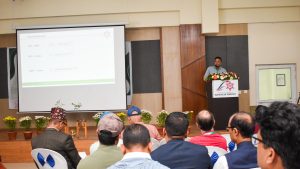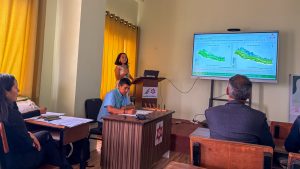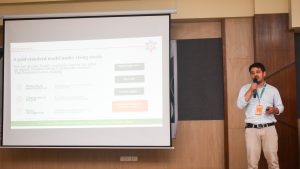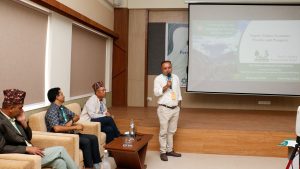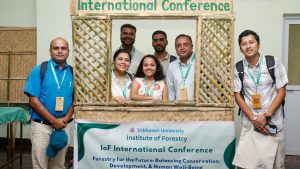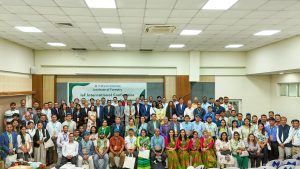

The Institute of Forestry (IoF), Tribhuvan University (TU), Nepal, organised the IoF International Conference from 14–16 August 2026 under the theme “Forestry for the Future: Balancing Conservation, Development, and Human Well-Being.”
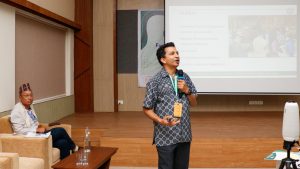
ForestAction Nepal had the opportunity to present its research during the plenary session titled “Unlocking Nepal’s Timber Economy,” which explored the foregone and untapped economic potential of Nepal’s forestry sector. The research presented during the session focused on the current status, production potential, and market demand of timber across the country. The findings highlighted the significant gap between Nepal’s available timber potential and its actual production, emphasising the opportunity costs associated with underutilisation in terms of revenue generation and employment opportunities.
Following up the session, another presentation by fellow researcher at ForestAction Nepal was shared on “The political economy of timber in Nepal,” exploring the institutional and political factors that influence timber harvesting and forest management. His presentation examined the roles and power dynamics of key actors, persistent institutional stagnation, competing interests, and political influences affecting timber production. It further examined how existing policies, regulatory frameworks, and operational practices influence Nepal’s timber production potential.
Together, the presentations contributed to a broader discussion on how Nepal can unlock the economic potential of its forestry sector while maintaining sustainable forest management, strengthening governance, generating employment, and promoting the well-being of forest-dependent communities.
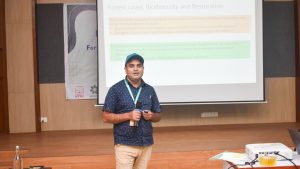
Beyond the plenary, ForestAction Nepal researchers also presented their work across the conference’s parallel sessions, contributing to discussions on forest restoration, forest fire management, and forest biometrics.
Research presented under the session, Forest Biometrics and Quantitative Forest Assessment, explored estimating trespassed volume of Sal (Shorea robusta Gaertn.) tree from the stump diameter in Eastern Nepal, offered practical, field-based method for quantifying timber loss from illegal felling, contributing to more accurate assessment of unauthorised harvesting and strengthening forest monitoring efforts in Sal-dominant forests.
Similarly, under the Forest Fire & Post-Fire Recovery session, research on forest fire management assessed the labour costs and risk perceptions associated with fire management activities, highlighting the limitations of relying solely on voluntary community labour and making the case for incentive-based mechanisms that better recognise the risks borne by community members engaged in fire prevention and control.
One of the researcher also presented on Reimagining Forests: Restoration and Social–Ecological Systems, arguing for restoration success to be measured beyond simple forest cover metrics, examining how ecological and social outcomes vary depending on the management regime in place, and offering evidence to inform more nuanced, outcome-based approaches to assessing restoration effectiveness in Nepal.
Similarly, Dr. Lila Nath Sharma contributed under the session on Forest Restoration & Regeneration, presenting on “Reframing Nepal’s forest restoration from cover to biodiversity for resilient landscape.” His presentation argued that cover-centric restoration targets can mask underlying ecological degradation and called for restoration indicators that better capture biodiversity gains and long-term landscape resilience. Dr. Sharma also chaired a parallel session on Climate-Smart Tree-Based Systems for Resilient Landscapes.
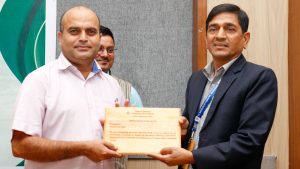
Through these contributions, ForestAction Nepal brought evidence-based perspectives and findings to discuss on sustainable and resilient forest management, stregthening links between research, policy and practice. ForestAction Nepal expresses its gratitude to Institute of Forestry, Tribhuvan University for the valuable organisation of such a timely event.