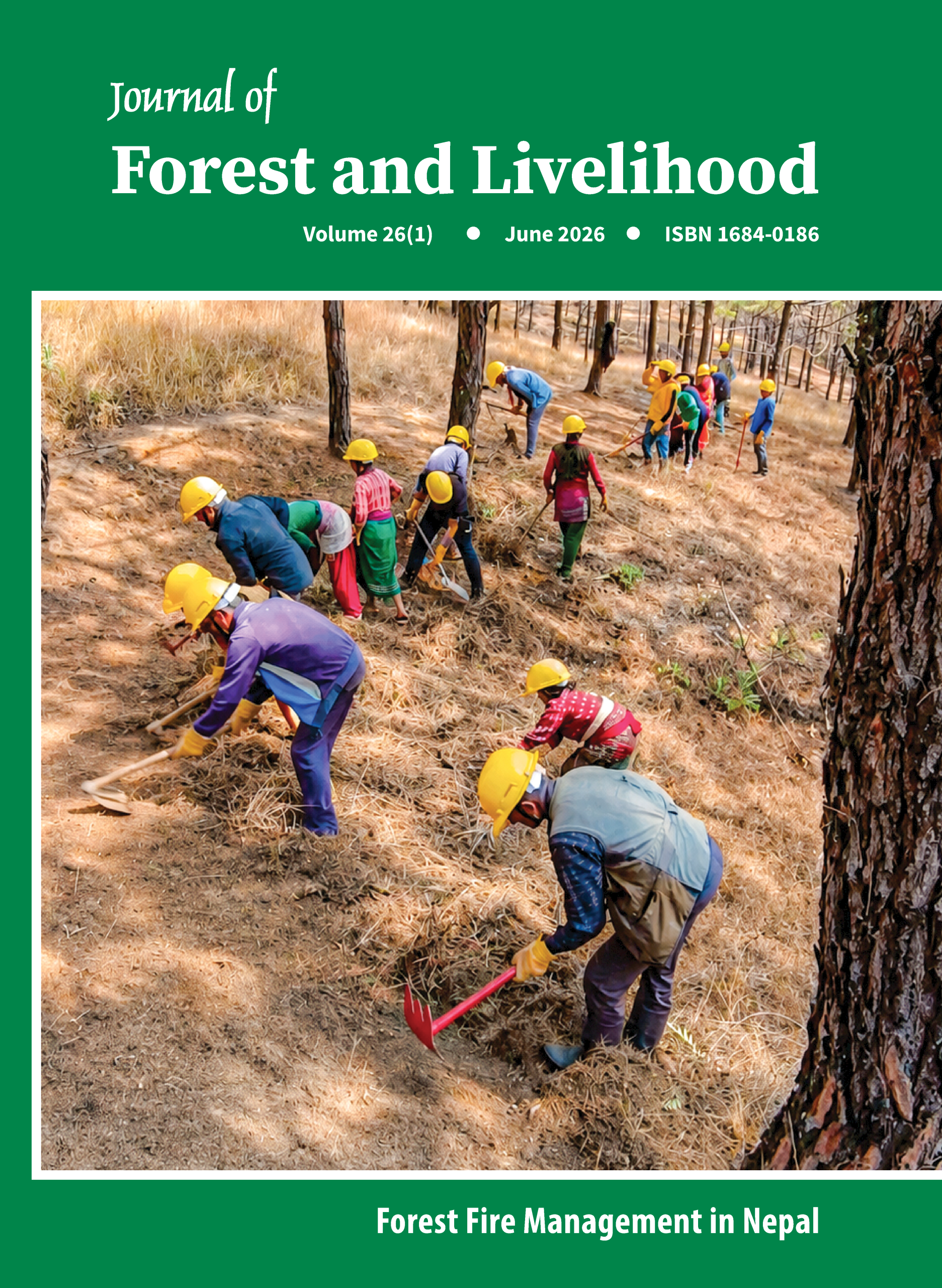
Vol. 26 No. 1 (2026): Special Issue on Forest Fire Management in Nepal

Nepal’s forest fires have escalated from seasonal events to a recurring hazard, with more than 34,700 incidents recorded since 2008. While hotter and drier conditions elevate fire weather risks, impacts are amplified by institutional fragmentation and weak incentives for prevention and response. Post 2015 federal restructuring has delegated authority across different government tiers, though the clarity of roles and responsibilities and the outcomes is still a question. On the other hand, contributions of local communities and community-based response to forest fires have largely remained voluntary, that is compounded by lack of tools and capacity, thus posing risks to lives and property. A shift from episodic suppression to risk-based stewardship is required, centered on a clarified operational command structure, dedicated preparedness financing, and formal recognition of community’s role as an essential service. Effective fire management in federal Nepal demands clearly delineated roles across a range of actors. Nevertheless, a well-established, operational chain of command remains absent. In practice, overlapping mandates can leave municipalities accountable for outcomes but constrained in both authority and resources. To address these concerns, this special issue of the Journal of Forest and Livelihood brings together interdisciplinary research and perspectives on forest fire management, highlighting the key issues, challenges, and emerging approaches in the Nepalese context.


Articles:

Adhikari, G., Yadav, N. K., Joshi, K. P., Mahara, S., Chad, D., Gaire, D., & Subedi, R. (2026). Spatial non-stationarity in forest fire driving factors in the lowlands of Nepal: A case study of Madhesh Province. Journal of Forest and Livelihood, 26(1), 1–23. https://doi.org/10.3126/jfl.v26i1.96629

Bhattarai, K., & Pandey, C. L. (2026). Assessment of forest fire incidences, causes, and management practices in Bagmati Province, Nepal. Journal of Forest and Livelihood, 26(1), 24–44. https://doi.org/10.3126/jfl.v26i1.96637

Sharma, S., Gautam, A. P., Parajuli, A., & Parajuli, M. (2026). Assessing forest fire risks using geo-spatial techniques in western Nepal. Journal of Forest and Livelihood, 26(1), 45–67. https://doi.org/10.3126/jfl.v26i1.96638

Parajuli, R., Paudel, A., & Sharma, L. N. (2026). Maintaining people-forest interactions is critical to managing forests fires in Nepal. Journal of Forest and Livelihood, 26(1), 68–82. https://doi.org/10.3126/jfl.v26i1.96645

Rai, R. K. (2026). Challenges and opportunities in forest fire management in Nepal: An economic perspective. Journal of Forest and Livelihood, 26(1), 83–88. https://doi.org/10.3126/jfl.v26i1.96646

Shrestha, M., K.C., D., Karki, R., & Bashyal, M. (2026). From voluntarism to incentivised forest fire management in Nepal: Evidence on labour costs and risk perceptions from four CFUGS. Journal of Forest and Livelihood, 26(1), 89–107. https://doi.org/10.3126/jfl.v26i1.96647

Ojha, K., & Koirala, A. (2026). Forest fire policy efforts in Nepal: Present status and future vision. Journal of Forest and Livelihood, 26(1), 108–128. https://doi.org/10.3126/jfl.v26i1.96648

Hill, A., & Shrestha, M. (2026). Institutional fragmentation and forest fire management in federal Nepal: Bridging the governance gap through incident management systems. Journal of Forest and Livelihood, 26(1), 129–141. https://doi.org/10.3126/jfl.v26i1.96653

Bhattarai, B., Shrestha, K., Gurung, P., Sapkota, P., & Ojha, H. (2026). Anticipatory forest-fire risk governance in Nepal. Journal of Forest and Livelihood, 26(1), 142–154. https://doi.org/10.3126/jfl.v26i1.96656
Tiwari, S., Timilsina, R., Pasakhala, B., & Maraseni, T. (2026). Gender and social diversity integration in Nepal’s forest fire research: A systematic scoping review. Journal of Forest and Livelihood, 26(1), 155-174. https://doi.org/10.3126/jfl.v26i1.98657


2025 – JFL Vol 25 (1)

In this issue of the Journal of Forest and Livelihood, we introduce research articles around community forestry that focuses on landscape restoration, ecological resilience, and livelihood improvement and shed light on how they may lead to sustainable resource management.


Editorial

Staddon, S. 2025. The Politics of Care in Coping Well with Change: Conceptualising and Questioning Care to Move beyond ‘Resilience’ in Rural Nepal. Journal of Forest and Livelihood, 25(1): 1-21

Feiersinger, S. J.P.D., Stilma, A.A. and Chapagain, A. 2025. Impact of Operational Plans on Forest Cover Area: A Comparative Study of Community Forests in Nepal. Journal of Forest and Livelihood, 25(1): 22-34

Dahal, G.R. 2025. Significance of Community Based Forestry for Effective Forest Landscape Restoration. Journal of Forest and Livelihood, 25(1): 35-42

Khanal, K.P., Khatri, T.B., Nepal, S.M., Poudel, B.S., Sapkota, R., Thapa, B., Dahal, D.S. and Dhakal, B. 2025. Ecosystem Based Adaptation for Increased Water Availability: A Case Study from the Hills and Mountains of Nepal. Journal of Forest and Livelihood, 25(1): 43-55

Rajbhandari, S., Yadav, Y., Shrestha, P., Dahal, D., Sharma, G., Poudel, S. and Basnet, R. 2025. Role of NTFP-based Micro-enterprises in Livelihood Improvement of Forest User Group: A Case of a Sishnoo- based Micro-enterprise in the Mid-hills of Nepal. Journal of Forest and Livelihood, 25(1): 56-66

Shrestha, P., Mandal, R.A., Kandel, P., Rajbhandari, S., Sharma, G., Mahat, N., Poudel, S., Dahal, D., Budhathoki, A. and Basnet, R. 2025. Effects of Invasive Alien Plant Species (IAPS) on Native Plant Species in Three Different Altitudinal Range: A Case Study of Five Community Forests of Jajarkot District. Journal of Forest and Livelihood, 25(1): 67-78

Adhikari, J., Shrestha, M. and Gautam, A. 2025. Understanding local perception on NTFP availability in the Himalayan landscape of Nepal. Journal of Forest and Livelihood, 25(1): 79-93

Full Issue

2024 – Special Issue on Forest Based Enterprises Vol 24 (1)


2024 – Special Issue on Forest Based Enterprises, Vol 24 (1)

Community forestry is known to provide opportunities for economic development. Through small and medium scale enterprises, community forestry has generated income and employment to rural communities. However, it’s the potential on generating income and scalable business models has not been fully realized. Similarly, majority of the lucrative forest-based enterprises, for instance timber enterprisers, are largely dominated by men whereas small scale enterprises, mainly non-timber forest products (NTFPs) based, have involved women and have generated opportunities in terms of income and employment. Yet, women face struggles in terms of registering forest-based business, finance their enterprises, and selling their products, which are relatively less examined. Thus, evidence-based knowledge generation for linking women to productive resource-decisions, and entrepreneur linkage to enhance community-based enterprises for climate and social resilience is crucial.

This special issue on forest-based enterprises presents seven papers focusing on community forestry and women’s empowerment, barriers, and reforms in women’s access to resources, timber production potential and financial governance in CFUGs and success and challenges of community based enterprises.

Editorial

Baral, S., Tiwari, S., and Shrestha, K.K. 2024. Gendered Process of Women (dis)empowerment in the Community Forestry in Nepal. Journal of Forest and Livelihood, 24 (1): 1-21

Thakuri, U., Baral, S., Lama, K., and Khatri, A. 2024. Green Enterprises: A pathway to Women’s Economic Empowerment. Journal of Forest and Livelihood, 24 (1): 22-42

Bastakoti, B.P. 2024. An Inquiry into the Forest Based Enterprises Managed by Women through Group Based Enterprise Operation Model and Empowerment Outcome in Nepal: Cases from Sindhupalchowk and Nawalpur Districts. Journal of Forest and Livelihood, 24 (1): 43-61

Dangi, R. 2024. Timber Production Potentials in Nepal: A Critical Review on Projected Estimates. Journal of Forest and Livelihood, 24 (1): 62-76

Bista, R., Parajuli, R. and Song, C. 2024. Analysing the Financial Governance of Community Forestry in Mid-Hills of Nepal: A Case Study from Tanahu District. Journal of Forest and Livelihood, 24 (1): 77-94

Nepal, D. and Poudel, S. 2024. A Case Study on Entrepreneurial Motivation and Challenges faced by Women in Agri-entrepreneurship in Nepal. Journal of Forest and Livelihood, 24 (1): 95-109

Rai, J.K. 2024. Cultural Dimension of Community Based Forest Enterprise in Nepal: A Case of Handmade Paper Enterprise in Eastern Hill of Nepal. Journal of Forest and Livelihood, 24 (1): 110-132

2024 – Special Issue on Forest Based Enterprises Vol 24 (1) – Full Document

2022 – Special Issue on Forest Fire, Vol 21 (1)


2022 – Special Issue on Forest Fire, Vol 21 (1)


Bhujel, K.B., Sapkota, R.P. and Khadka, U.R. 2022. Temporal and Spatial Distribution of Forest Fires and their Environmental and Socio-economic Implications in Nepal. Journal of Forest and Livelihood, 21(1): 1-13.

Bhattarai, N. Dahal, S., Thapa, S., Pradhananga,S., Karky, B.S., Rawat, R.S., Windhorst, K., Watanabe, T., Thapa, R.B., and Avtar, R. 2022. Forest Fire in the Hindu Kush Himalayas: A Major Challenge for Climate Action. Journal of Forest and Livelihood, 21(1): 14-31.

Pandey, H.P., Pokhrel, N.P., Thapa, P., Paudel, N.S. and Maraseni, T.N. 2022. Status and Practical Implications of Forest Fire Management in Nepal. Journal of Forest and Livelihood, 21(1): 32-45.

Ranabhat, S., Pokhrel, A., Neupane, A., Singh, B. and Gahatraj, S. 2022. Forest Fire Risk Assessment and Proposal for Fire Stations in different Geographical Regions of Central Nepal. Journal of Forest and Livelihood, 21(1): 46-59.

Tiwari, S., Paudel, N.S., Sze, J. and Karki, R. 2022. Unravelling the Local Dynamics of Increasing Fires in Community Forests of Mid-hills of Nepal. Journal of Forest and Livelihood, 21(1): 60-71.

2021 – Generic Issue Vol 20 (1)

Acharya, S., Pathak, K. and Pandey, C.L. 2021. Does High-Value Agriculture Build Resilient Livelihood? Insights from the Study of Cardamom and Vegetable Farmers of Nepal. Journal of Forest and Livelihood, 20(1): 1-15.

Dinesh Adhikari, D., Prasai, R., Lamichhane, S. and Gautam, D. 2021. Climate Change Impacts and Adaptation Strategies in Trans-Himalaya Region of Nepal. Journal of Forest and Livelihood, 20(1): 16-30.

Anil Bhandari, A., Thakuri, S., Koirala, P. and Devkota, M.P. 2021. Conflict-Sensitive Climate Change Adaptation in Nepal: An Analysis of Climate Resilience Policy Frameworks. Journal of Forest and Livelihood, 20(1): 31-44.

Sharma, L.N., Tamang, S.R, Poudel, Y.B., Subba, A., Timsina, S., Adhikari, B., Shrestha, H., Gautam, A.P., Kandel, D.R., Watson, M.F. and Paudel, N.S. 2021. Biodiversity Beyond Protected Areas: Gaps and Opportunities in Community Forest. Journal of Forest and Livelihood, 20(1): 45-61. 

Timsina, S., Basyal, M., Dahal, K., Karki, R. and Paudel, N.S. 2021. What is Choking Nepal’s Domestic Timber Supply? Journal of Forest and Livelihood, 20(1): 62-77. 

2020 – Generic Issue Vol 19(1)

Dahal, G.R., Pandit, B.H. and Shah, R. 2020. Abandoned Agricultural Land and its Reutilisation by Adoption of Agroforestry: A Case Study from Kaski and Parbat Districts of Nepal. Journal of Forest and Livelihood, 19(1): 1-16.

Pandit, B.H., Nuberg. I., Shrestha, K.K., Cedamon, E., Amatya, S.M., Dhakal, B. and Schmidt, H.P. 2020. Revitalising Agrarian Economies: The Use of Biochar on Banana-based Agroforestry System in Nepal’s hills. Journal of Forest and Livelihood, 19(1): 17-31.

Ghimire, D.R. 2020. Empowering Women Producers through Value Chain Development in Commercial Vegetable Farming for Improved Livelihood and Food Security. Journal of Forest and Livelihood, 19(1): 32-50.

Pandey, H. P., Maaren, I. E., Shah K. K, and Maraseni, T. N. 2020. Response of Topographic and Biodiversity Variables on Biomass and Carbon Density in Community Forests of Himalayan Foot-hills. Journal of Forest and Livelihood, 19(1): 51-65.

2019 – Special Issue on Forest Cover Change in Nepal, Vol 18 (1)

Fox, J., Saksena, S., Hurni, K., Van Den Hoek, J., Smith, A.C., Chhetri, R. and Sharma, P. 2019. Mapping and Understanding Changes in Tree Cover in Nepal: 1992 to 2016. Journal of Forest and Livelihood, 18 (1): 1-11.

Tachibana, T., Adhikari, A., Rayamajhi, S. and Sakurai, T. 2019. Green Makes a Bold Comeback! Inventory Results of 101 Natural Forests in the Middle Hills of Nepal over Two Decades. JJournal of Forest and Livelihood, 18 (1): 12-25.

Uddin, K., Matin, M.A., Dhanju, H.K., Bajracharya, B., Flores, A., Anderson, E. and Ellenburg, L. 2019. Remote Sensing Based Deforestation Monitoring at the Change Hotspot Area in Hindu Kush Himalayan Region. Journal of Forest and Livelihood, 18 (1): 26-38.

Shrestha, H.L., Poudel, N.S., Bajracharya, R.M. and Sitaula, B.K. 2019. Mapping and Modelling of Land Use Change in Nepal. Journal of Forest and Livelihood, 18 (1): 39-53.

Pandit, B.H. 2019. Forest Gardening on Abandoned Agricultural Land Contribute to Ground Cover Change and Food Security. Journal of Forest and Livelihood, 18 (1): 54-65

2018 – Special Issue on REDD+ in the Hindu Kush Himalayas, Vol 17 (1)

Editorial

Banikoi, H., Karky, B.S., Shrestha, A.J., and Aye, Z.M. 2018. A Value Chain Approach to Sustainable Forest Management? Timber Supply Chain Practices for Sustainability in Myanmar’s Forest Sector. Journal of Forest and Livelihood, 17 (1): 1-15.

Basnet, S., Sharma, P., Timalsina, N., and Khaine, I. 2018. Community Based Management for Forest Conservation and Livelihood Improvement: A Comparative Analysis from Forests in Myanmar. Journal of Forest and Livelihood, 17 (1): 16-33.

Bhattarai, N., Verma, N., Rawat, R.S., Karky, B.S., and Rawat, V.R.S. 2018. Addressing Driver of Deforestation and Forest Degradation in Mizoram through Sub-National REDD+ Action Plan. Journal of Forest and Livelihood, 17 (1): 34-48.

Laudari, H.K., Pant, B., Timalsina, N., Dhungana, S.P., Poudel, M., and Karky, B.S. 2018. Decentralising REDD+: Lessons Learned from “Redd+ Himalaya Project” of Nepal.  Journal of Forest and Livelihood, 17 (1): 49-62.

Bhandari, T.S., Timalsina, N., Pant, B., Laudari, H.K., Bhattarai, S., Wagle, R., Dhungana, S.P., and Karky, B.S. 2018. Inclusion of Gender Issue in REDD+: Experiences from REDD+ Pilot Implementation in Nepal.  Journal of Forest and Livelihood, 17 (1): 63-75.

Chand, J., Windhorst, K., Poudel, M., and Bhattarai, N. 2018. Subnational Capacities Strengthened by REDD+ Himalaya Project in the Districts of Nepal.  Journal of Forest and Livelihood, 17 (1): 76-89.

Poudel, M. and Poudel, A.K. 2018. Forest Reference Levels in the Hindukush Himalaya: A Comparative Overview.  Journal of Forest and Livelihood, 17 (1): 90-110.

Karki, R., Paudel, N.S., Adhikary, A., and Manandhar, S. 2018. Comparing and Contrasting National REDD+ Strategies in the Hindukush Himalayan Region: Implications for REDD+ Implementation.  Journal of Forest and Livelihood, 17 (1): 111-126.

Amatya, S., Yangden, K., Wangdi, D., Phuntsho, Y. and Dorji, L. 2018. National Forest Inventory of Bhutan: Shift in Role from Traditional Forestry to Diverse Contemporary Global Requirements.  Journal of Forest and Livelihood, 17 (1): 127-138.

2018 – Generic Issue Vol 16(2)

Luitel ,D.R., Siwakoti, M. and Jha, P.K. 2018. Relationship between Climatic Variables and Finger Millet Yield in Syangja, Central Nepal. Journal of Forest and Livelihood, 16 (2): 1-13.


2018 – Special Issue on Climate Change, NRM and Conflict. Vol 16(1)

This special issue of Journal of Forest and Livelihood presents different cases of conflicts over natural resource management. It also highlights innovations (institutional or others) to conflict resolution in management of natural resources in Nepal. Some of the papers bring insights on the impact of climate change on natural resources, and conflict as a byproduct of the alterations in the natural setting

Paudel, N. S., Bhusal, P., Thompson, P., Sultana, P., Adhikary, A. and Bhandari, K. 2018.Transforming Forest Conflicts: Learning from North-South Conflicts over Community Forests in Terai Region of Nepal. Journal of Forest and Livelihood, 16 (1): 1-14

Bhusal, P., Paudel, N.S., Adhikary, A., Karki, J. and Bhandari, K. 2018. Halting Forest Encroachment in Terai: What Role for Community Forestry? Journal of Forest and Livelihood, 16 (1): 15-34

Khatri, D., Maskey, G. and Adhikari, B. 2018. REDD+ and Community Forestry in Nepal: Strengthening or Paralysing Decentralised Governance? Journal of Forest and Livelihood, 16 (1): 35-55

Bhusal, P., Bamjade, M.R. and Paudel, N.S. 2018. Pastoralism in Crisis: Mounting Challenges in Herding System in High Altitude Region of Nepal. Journal of Forest and Livelihood, 16 (1): 56-70

Bhattarai, B., Bishwokarma, D. and Legras, M. 2018. Breaking the Bottleneck: Conflicts Metamorphosis of Chure Landscape Management in Federal Nepal. Journal of Forest and Livelihood, 16 (1): 71-86

Poudel, J. M. 2018 Pond Becomes a Lake: Challenges Posed by Climate Change in the Trans-Himalayan Regions of Nepal. Journal of Forest and Livelihood, 16 (1): 87-102

Neupane, B., Budhathoki, S. and Khatiwoda, B. 2018. Human-Elephant Conflict and Mitigation Measures in Jhapa District, Nepal. Journal of Forest and Livelihood, 16 (1): 103-112

2017 – Journal of Forest and Livelihood 15(2)


Giri, A., Giri, R., Nelson, V., Lovercamp, K., Sharma, S. and Protopo, I. 2017. Can Nepal Attain Self-Sufficiency in Major Crops Production? Journal of Forest and Livelihood, 15(2): 1-12

Adhikari, J. 2017. Organic Farming and its Prospects in Peri-urban Area of Pokhara, Nepal. Journal of Forest and Livelihood, 15(2): 13-31 

Subedi, Y.R., Mulia, R.,Cedamon, E., Lusiana, B., Shrestha, K. and Nuberg, I. 2018. Local Knowledge on Factors Leading to Agroforestry Diversification in Mid-hills of Nepal. Journal of Forest and Livelihood, 15(2): 32-51

2017 – Forest Tenure Reforms in Nepal Vol 15(1)


Banjade, M.R., Paudel, N.S. and Mwangi, E. 2017. Introduction: Political economy of forest tenure reform implementation in Nepal: Evolution, contestation, outcomes and challenges. Journal of Forest and Livelihood, 15(1): 1-14

Dahal, G.R., Pokharel, B.K, Khanal, D.R. and Pokhrel, P.R. 2017. Why Does Tenure Security Matter in Community Forestry? A Critical Reflection from Nepal. Journal of Forest and Livelihood, 15(1): 15-26

Dhungana, S.P., Satyal, P., Yadav, N.P. and Bhattarai, B. 2017. Collaborative Forest Management in Nepal: Tenure, Governance and Contestations. Journal of Forest and Livelihood, 15(1): 27-42

Kafley, G.P. and Pokharel, K. 2017. Pro-poor Leasehold Forestry: A Community-based Tenure Regime in Nepal. Journal of Forest and Livelihood, 15(1): 43-56

Thing, S.J, and Poudel, S.P. 2017. Buffer Zone Community Forestry in Nepal: Examining Tenure and Management Outcomes. Journal of Forest and Livelihood, 15(1): 57-70

Gautam, A.P., Bhujel and Chhetri, R. 2017. Political Economy of Forest Tenure Reform Implementation in Nepal: The Case of Protected Forests. Journal of Forest and Livelihood, 15(1): 71-86

Singh, B.K. 2017. Land Tenure and Conservation in Chure. ournal of Forest and Livelihood, 15(1): 87-102

Acharya, D. and Baral, N.R. 2017.Neglected High Altitude Rangelands of Nepal: Need for Reform. Journal of Forest and Livelihood, 15(1): 103-119

Amatya, S.M. and Lamsalm P. 2017 Private Forests in Nepal: Status and Policy Analysis. Journal of Forest and Livelihood, 15(1): 120-130

Wagle, R., Oli, D., Sapkota, B., Aryal, S. and Prajapati, S.M. 2017. Feminist Institutionalist Interpretation of Forest Tenure Regimes in Nepal. Journal of Forest and Livelihood, 15(1): 131-142