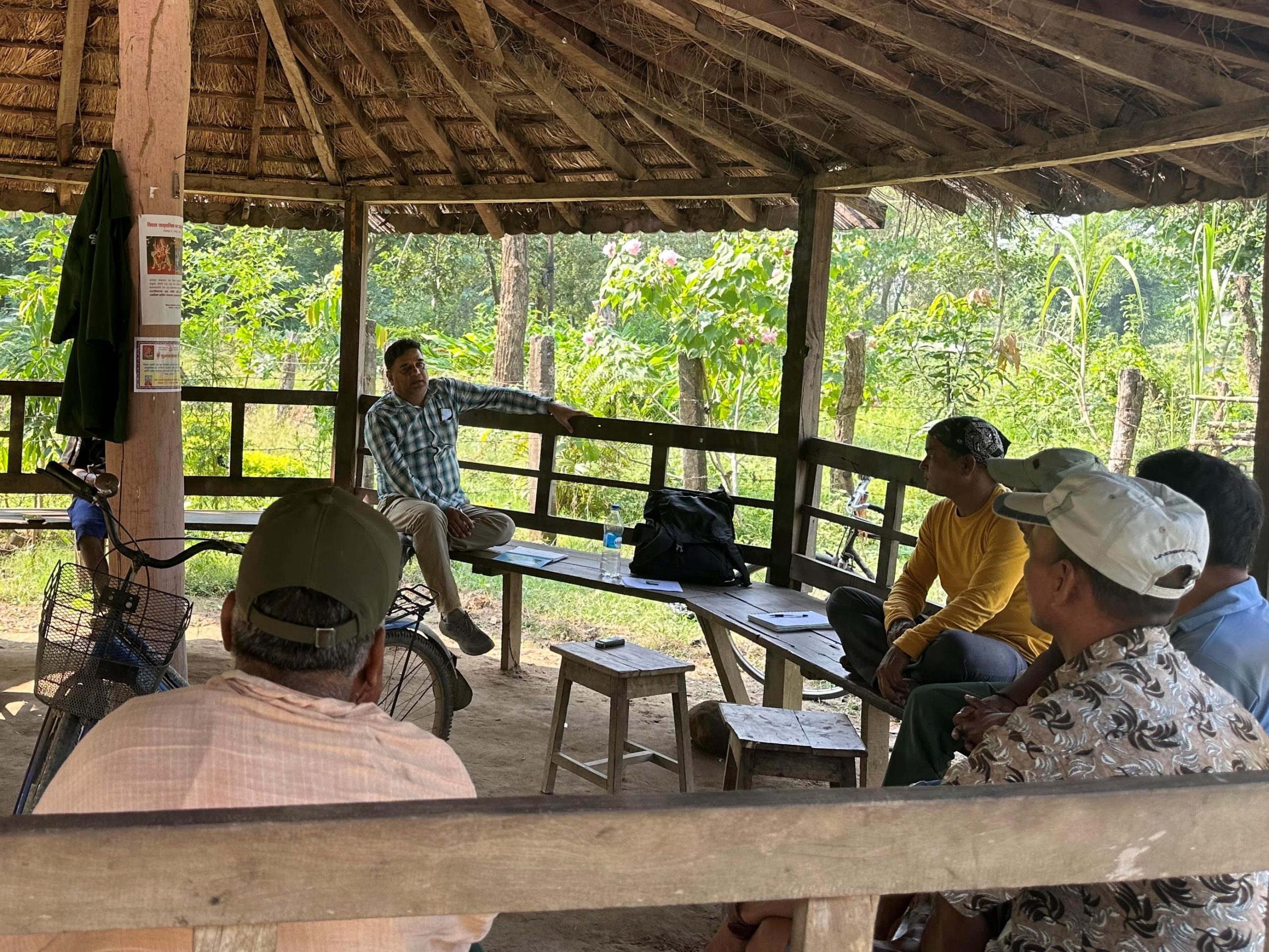
Training on agroecology and permaculture design and practice

Training on agroecology and permaculture design and practice

ForestAction Nepal organized and facilitated the second module of a training session on “Agroecology and permaculture design and practice” in Kauche, Sindhuli, from September 13th to 18th, 2024. The training had 17 participants and was led by primary instructors Bharat Mansata, a renowned writer, natural activist, and founder of Vanvadi, a collective forest regenerative initiative, and Malvika Solanki, an experienced permaculture designer and practitioner from India.

The training methodology integrated various learning approaches, such as presentations, interactive discussions, group work, and hands-on field exercises. The second module covered topics like flows and edges, patterns, energy storage and resources, mapping, biodynamic farming, community-scale design, siting and orientation of buildings, urban permaculture, and designing for catastrophes. This module was focused on hands-on experience in permaculture design. The participants were divided into four groups and were assigned projects.

Land-based project: site analysis and assessment, water management, soil improvement, sector analysis, functional analysis, zone mapping, base map, infrastructure development and placement, waste management, disaster preparedness

Market-based project: market survey/assessment, product selection and diversification, branding and storytelling, marketing channels, packaging and distribution, pricing strategy, feedback

Cooperative project: sector analysis, zone mapping, SWOT analysis, strategies, working approach

Urban design project: site assessment, mapping, zoning, maximizing space efficiency, water harvesting, waste reduction and recycling, culture, traditional food

On the final day, participants presented their project design. A detailed review and a reflection session were conducted to assess the overall training experience. The participants shared their insights, learnings, challenges, and positive takeaways from the training.


 

A Walking Training: Capacity building through observation, learning, and reflection

A walking training was conducted from August 27th to 31st, 2024, with the participation of 18 agricultural graduates, technicians, and social agents in the Lalitpur and Kavrepalanchok districts.

The journey started from Lubhu and concluded at Lakuribhanjyang of Lalitpur district on the first day. During the visit, participants did a brief observation of commercial agriculture and interacted with farmers. Participants also discussed the challenges faced by commercial farmers, especially about the emergence of new diseases and pests.

The second day of the journey began in Lakuribhanjyang and concluded at Kushadevi, Kavrepalanchok. Along the way, the participants interacted with farmers in the community and learned about their cropping pattern, cultivation practices, and their views on sustainable farming. Similarly, participants communicated with officials of Ward 1 of Panauti municipality to understand about the situation of commercial farming, community forestry, and pesticide use in that area.

In the third day, the journey started from Kushadevi and ended in Khopasi. Along the way, participants observed cropping patterns, land grabbing, forest fires, and landslides. Similarly, participants met with the agriculture officer of the Panauti municipality to discuss soil health conditions and the use of chemical fertilizers and pesticides in the area. Moreover, participants visited the sericulture development center and explored the potential of silkworm farming in Nepal.

The journey started from Khopasi on the fourth day and ended in Bethanchowk. During this portion of the walk, the participants observed the agricultural practices and livestock farming of the community. Participants had a brief discussion about land and water management, integrated pest management, and the impacts of chemical fertilizers and pesticides on human health in Bethanchowk.

On the fifth day, participants traveled to Narayanthan, where they visited a sacred Vishnu temple and enjoyed views of the Himalayas, including Ganesh, Langtang, Manaslu, and Everest. The training concluded with a self-reflection session to assess its impact on the participants’ learning and development.

Localizing activities and transforming Invasive Species Management

Infestation of invasive species especially Mikania macrantha, Lantana camara and Chromolaena odorata has largely impacted the forest ecosystem and livelihood of forest-dependent people across the lowland forests of Nepal. The biological invasion has suppressed tree regeneration, negatively affected biodiversity and decreased forest ecosystem services. The conventional method of invasive species control used by Community Forest User Groups (CFUGs) have been inadequate, ineffective and not informed by attributes of species and native ecosystems. To address this, ForestAction Nepal led Jalthal Biodiversity Project introduced a new approach to manage invasive species and protect natural regeneration of native species. This project considered the ecology and phenology of invasive species and prioritized bush cleaning in the summer to maximize the growth of native seedlings and suppress the regrowth of invasive species. Conventionally, bush cleaning used to be in winter season. The project has also conceptualized that invasive species management should be a part of long-term forest restoration rather than a discrete activity.
 
In the third year of the Darwin project Biodiversity Challenge Funds (UKBCFs), the project supported and collaborated with community forests of Jalthal Jhapa to remove invasive species during monsoon season. Invasive species removal and natural regeneration protection were performed in Nine CFUGs of Jalthal, restoring approximately 36 hectares of an invasive-infested area. The activity has rescued over 23,000 seedlings of 40 native tree species. Bush cleaning activity in these CFs involved over 180 local people equivalent to 900 person/days. The removal of invasive species was a collaborative effort involving CFUGs, the DFO Jhapa, and FECOFUN Jhapa.

Final Module of Immersion Course on Madesh for Social Transformation.

ForestAction Nepal, in collaboration with the Centre for Educational Policies and Practices (CEPP) and the Nepal Madesh Foundation (NEMAF), successfully completed the final series of the “Immersion Course on Madesh for Social Transformation.” This five-days residential training took place at the Lalghad Leprosy Hospital in Dhanusha from the 17 to 22 July 2024, with a total number of 17 participants.

The primary goal of this final series was to build basic knowledge and understanding of the key issues around agriculture, education, and public health. The training utilized a variety of learning techniques, including PowerPoint presentations, engaging discussions, collaborative group activities, informational videos, and exposure visits to an organic farm and a government school.

During the farm visit, participants observed sustainable farming techniques and learned about the benefits of organic agriculture. Similarly, the school visit provided insights of effective practices in government schools, emphasizing the role of an active School Management Committee (SMC) and showcasing effective teaching and learning methods through interactions with teachers and students. Participants gained knowledge and understanding of the connection between health and the food we consume.

The final series of immersion course successfully enhanced participants’ knowledge and skills in education, agriculture, and public health. The combination of theoretic knowledge and practical site visits contributed towards a well-rounded learning experience, equipping participants to implement such knowledge in their lives.

Interaction with media on the contemporary issues of food and agriculture

ForestAction Nepal has been working actively for promotion of Agroecology in Nepal, through collaboration with various stakeholders. The organization’s emphasis on media mobilization as a key strategy to raise awareness about food and agriculture issues is crucial for promoting Agroecology in Nepal. By working closely with agricultural journalists and organizing interactive workshops, ForestAction Nepal ensures that contemporary food and agriculture issues are highlighted and discussed.

In line with this approach, a half-day interactive workshop was held in Tokha, Kathmandu on July 27, 2024. The workshop brought together a diverse group of participants, including a Parliamentarian from Bagmati Province, the Mayor of Tokha Municipality, government officials from the Ministry of Agriculture, the Chairperson of the National Farmers Groups Federation, members of the Alliance of Agriculture for Food and agricultural journalists representing various media houses.

During the workshop, the participants engaged in discussions focusing on the crucial role of the media in amplifying the voices of smallholder, landless, and women farmers. Challenges faced by agricultural journalists in accessing authentic data from the government and in covering agricultural issues were also discussed.

Despite these challenges, the journalists expressed their commitment to addressing various agriculture-related issues in the media and also sought for support and collaboration with key stakeholders to strengthen their efforts and improve the representation of agriculture in the media.


Footprint of Development on Remnant Forest Distorted Demography of Iconic Latahar Tree

Fruits strike on the forest floor!

On a hot and humid afternoon of July 9, 2022, we ventured deep into Chaukibiran Community Forest (CF) in Jalthal to observe the flowers and fruits of trees. While we were on a short break for snacks in a serene area of the forest, something suddenly struck the ground with a loud noise, startling me. Noticing my reaction, Mr. Chiranjibi Paudel, our local guide for the walk, pointed at a tall tree mentioned “It’s nothing – just a Latahar fruit falling”. He was right; a fruit from the Latahar tree had fallen, scattering over 50 yellowish seeds beneath the canopy. Fortunately, our heads were safe from the fall!

Figure 1: Latahar seeds splash.

Upon testing the pulp of the fruit, I was hit with a familiar taste of Jackfruit. Jackfruit is familiar to many of us. Latahar, However, is unknown in the central and western Nepal. This South East Asian species of tropical forest does not grow in the central and western Nepal. In order to see the tree, I had to travel 500km east from my hometown, Gaindakot.

During July, it is common to witness the sight and sound of falling Latahar fruits in the Jalthal forest. The forest is filled with sweet aroma of ripen fallen fruits and buzz of flies feasting on its sweet pulp. For nature lovers, it’s exciting to see a bright orange carpet of seeds in the forest! While Mr. Sanchahang, Limbu of Bishal CF mentioned “during month of Asar and Saunan,, the floor below Latahar tree is colored with the yellowish pulps and seeds of Latahar and it is difficult to find open area to put feet”. Mr Limbu called the scene as ‘biskun sukaae jastai’ which means its like drying grains on the floor.

Every rainy season, hundreds of thousands seeds fall on the ground in Jalthal forest alone. Given the huge size of the fruit and its seeds, most of the seeds do not fall far from the shade of their mother trees, while few get dispersed by help of animals. Those fallen seeds start to germinate within the time span of 2 weeks. In September and October, the forest floor beneath the mature Latahar canopies are teeming with thousands of new seedlings.

Among the hundreds of thousands of seedlings growing during the late monsoon, only a few are lucky. One in every thousand seedlings, may survive to see the next monsoon. In the following sections, taking a case of Jalthal forest, I highlight fate of such seedlings.

Latahar: an iconic tree of tropical forest

Figure 2: Ripening Latahar fruit.

Latahar, Artocarpus chama as named by botanists, comes from the genus of Jackfruit tree in the family of figs. The tree is native to the moist tropical and subtropical forest of South East Asia. It is a large deciduous tree reaching as tall as 40 meters. The structure of the tree at the top forms a round crown above an unbranched bole (trunk) of 10-20 meters. When I measured the trunk circumference, it was as large as 5 meters. In midst of other trees, the Latahar tree stands tall with its round crown adorned with dark green foliage, displaying an impressive appearance. This iconic tree stands out, with its unique look among its associates!

Latahar is a multipurpose tree species who’s utilities range from consumption to furnishing. Although the fruit shares similarities with Jackfruit, it is much smaller in size and is generally round. The ripe Latahar fruits are consumed raw and the unripe ones are cooked into delicious pickle or vegetable curry. The rich dark green leathery leaves are used for fodder. Similarly, the thick and unbranched trunk yields good quality timber for furnishing. The tree also holds importance as shelter and food for different reptiles, birds and animals. Epiphytic mosses, ferns and wild orchids are also seen growing along the trunks and branches of the tree.

Latahar’s essence goes beyond its ecosystem services. Analyzing its regional and national distribution and presence demonstrates its phytogeographical importance and role in our ecology. Although this majestic tree species has a wide regional distribution, it holds limited presence in Nepal. Starting from Nepal, it spans through India, Southern China, Bangladesh, Bhutan, Myanmar, Laos, and Thailand, growing eastward all the way to Malaysia.

Jalthal, a forest island in the densely populated region in Southeastern corner of Nepal, is a prime habitat for Latahar. In spite of its 0.1% shares in Nepal’s forest, the forest patch serves as a natural museum of trees due its ability to sustain over one-quarter of the country’s 600 tree species. The forest is also a home to the natural groves of Latahar tree which gives Jalthal forest a unique identity among Nepalese forest types.

Figure 3: Cross section of Latahar fruits.

Eastern Nepal marks the last resort of distribution of this south east Asian species’ west bound. In Nepal, this species grows in the foothills of Chure and in Sal forests of eastern Terai mainly in Jhapa, Morang, and Sunsari districts. Although, it has not been reported in the west of Koshi River, it might have held its presence in the central Terai in the past.

Where do seedlings of Latahar go?

During the late monsoon, hundreds of thousands of Latahar seeds which germinate, do not survive the following year. In order to maintain a healthy population of the unique tree, there is a dire need for the germinated seedlings to establish and grow mature. Even in its natural and undisturbed habitat, all the seedlings emerged do not get the opportunity to thrive as they undergo self-thinning overtime. Since, most of the seedlings fall under the shadow of their mother tree, where they cannot grow bigger. Seedling need to face attacks from herbivores, disease and pests. Therefore, among the germinated seeds, only a few are recruited and matured in order to maintain the population of the tree species.

Figure 4: A dense layer of Latahar seedlings

Since 2019, I am closely looking at regeneration and population of Latahar. The regeneration of Latahar forest is not running naturally in the forest. Since the forest is surrounded by human settlements, it inevitably experiences the effects of nearby agricultural and economic activities. A huge population depends on the forest to sustain their livelihood through collection of forest products, primarily, fodder and firewood. As, young Latahar seedlings and saplings work as good fodder, it is an obvious and easy target for the fodder collectors.

While Jalthal forest does hold reputation for its rich and unique biodiversity, it is also gradually engulfed by expansion of various invasive species, mainly Mikania micrantha. This species forms a thick mat on the surface during the monsoon and post monsoon time. The mat of Mikania is threatening the establishment of Latahar seedlings.

While walking through Latahar Danda in Bishal CF, I noticed very widely spaced Latahar trees and the space between them was filled with green mat. The mat was not formed by native trees but by invasive alien species of plants like Lantana and Mikania. Mr Limbu highlighted that invasive species enhance forest fire in dry season. Fire in the forest is mostly deliberate and sometimes due to negligence. Fire along with fodder collectors decimate almost all of the seedlings grown during monsoon.

Figure 5: Presence of Mikania cover between widely spaced Latahar trees.

Distorted demography

Despite being threatened by felling, fire and invasive species, it is remarkable to note that 6,100-hectare Jalthal forests, in my crude estimation, still sustains over 250 old-grown Latahar trees. Paradoxically, I have also noticed the absence of saplings and pole-sized trees, which would replace the old-grown trees in coming decades.

For a healthy tree population, there should be higher number of smaller or middle-aged trees compared to old-grown ones. Similar to a human society comprising of senior citizens, youths, and children, a natural old-growth forest should feature a mix of individuals of various ages. However, such situation is lacking with Latahar trees in Jalthal forest. Presence of only old grown trees and lack of young and middle sized trees indeed is a distorted demography of the species. This distortion alarms a looming future of the species.

Development: Major culprit of distortion

The demographics of Latahar in Jalthal not only demonstrates current regeneration and population issues, but also reflects the changed intensity of human-environment interactions. For centuries, Jalthal forest experienced low-intensity use, resulting in minimal impact on its structure.

Since 1950s, the population of the southern lowland plunged with Malaria eradication, planned resettlement, and construction of East-West highway. Such activities first deforested and fragmented the otherwise lush continuous forest called as Charkoshe jhadi. Then, human population directly degraded the remnant patch by felling and lopping, and cutting of saplings for fodder. In an interaction with an elderly Rajbanshi and Meche people they did not recall fodder collection from the forest when they were young some five decades ago. However, now fodder collection from the forest is regular activity for people taming livestock.

Figure 6: Forest survey team measuring the girth of old grown Latahar tree

With migration of people from Hill to Terai region, the pressure on forest has increased immensely, affecting Latahar and other species. Consequently, this has affected the growth environment of Latahar seedlings. For the last four-five decades, the seedling of this plant has not developed into its normal course, rather they are decimated within a year or two of germination. The pressure for fodder and firewood has gradually degraded forest and the rapid growth of invasive species mainly Mikania has further restrained the development of Latahar seedlings.

Latahar in Jalthal represents the case of forest degradation where forest is subjected to slow and continuous disturbance rather than a large scale felling and deforestation. Ecologists terms such low but a continuous disturbance as ‘chronic disturbance’. Although such disturbance seems gradual and almost unnoticeable, it eventually leads to significant damage, sometimes irreversible damage. Unfortunately, we lack accounts of biodiversity erosion based on credible and longitudinal data. It is crucial for researchers to analyze the impact of chronic disturbance on biodiversity erosion and forest managers to respond to the chronic disturbance.

Nepal needs proper assessment of its tree flora

Ministry of Forests and Environment of Nepal conduct nationwide survey of forests and organize plant collection expeditions. While these activities provide general overview of forest condition and occurrence of species, these data are not adequate for management at species level. These general data are even less informative for species that are rare, clumped and habitat specialists. There are several published and grey literatures reporting tree data of certain area at certain point in time. Credibility of large fractions of such reports, however, is dubious in lack of rigor of survey methods and data quality including taxonomic precision. Various tree survey reports conducted in Nepal have often failed to produce any robust narrative that attracts attention of local people or policy makers for conservation actions.

We largely rely on IUCN red list to identify species’ threat status. Relative to flora, IUCN data have much information for faunal species, particularly the vertebrates. In 2021, a comprehensive assessment of trees of the world was produced by Global Tree Assessment (GTA) initiatives. Available global database like GTA and IUCN red list may not reflect status of local population of a particular species. This is evidenced in case of Latahar tree. Given its wider global distribution and abundance within the distribution range, the species might have not been assessed by IUCN. Latahar might not be threatened globally but it appears locally threatened given its current local demographic structure in its westernmost region of distribution, i. e. in the eastern Nepal. Nepali researchers have a long and wide avenue to contribute in tree population data through well designed and monitored plot data. Assessing demography of rare, endemic, threatened and habitat specialist trees could be a starting point towards a comprehensive tree data.

Restoring the iconic tree

Mr. Sachahang Limbu, the leader of Bishal Community Forest has interest in conserving trees of Jalthal forest. He is keen in exploring and collecting seeds for propagation. In March 2023, I had an interesting interaction with him while walking through the Latahar Danda in his CF. I was curious about ways to fill out the gaps between the widely spaced Latahar trees, to which he swiftly replied “controlling fodder collection”.

Mr. Limbu rightly identified human interference as the major issue for the conservation of the species. Given the nature of our rural livelihood and dependency on forest, it’s impractical to ban fodder collection; however there is the aspect of management of fodders. With sincere efforts to manage the forest, Latahar population can be revived. The current forest management favoring protection of Sal, needs to be wider enough to incorporate ecological data. Unfortunately, most of the forest management often incentivizes plantations, often overlooking nurturing natural regeneration which is an ecologically sound and cost effective methods of restoring degraded forest.

The people who collect forest fodder are economically vulnerable population who are residing near the forest. Providing them with alternative will generate dual benefit of improving the livelihood of people and enhancing forest health. Similarly, management of forest patches for regeneration protection and prevention of forest fire can contribute in restoring a healthy population of the forest giant. It’s time to act seriously to protect our natural heritage, Jalthal forest and its rare, unique and threatened trees that adorn the forest with unique identity!

At the end, realizing the crucial role of fodder management for effective conservation of plant species in Jalthal forest, ForestAction Nepal’s Jalthal biodiversity project funded by Darwin Initiative UK has prioritised fodder species plantation both in forest and private lands. Among others, the project is working with communities in protecting existing natural regeneration and needful plantation of native species. One key activity towards this is propagation of species, that are facing regeneration problem in natural habitats, in a nursery. The project is working with diverse stakeholders to ensure conservation of rare and threatened trees through various activities including conservation education, in situ interaction, species re-introduction and capacity enhancement.

A short version of this blog can be found here: https://nepalitimes.com/opinion/seeing-the-forest-and-trees-in-nepal
Various actions organised to conserve rare and threatened trees in Jalthal can be found here https://forestaction.org/publications/conservation-of-plant-diversity-with-emphasis-on-rare-and-threatened-trees-in-jalthal-remnant-forest/

Sharma work in Jalthal Biodiversity project in Jhapa

Interaction program on “Challenges on implementation of agricultural plans and policies”

On 15th July 2024, Monday, ForestAction Nepal, the secretariat of the Alliance of Agriculture for Food (AAF) in collaboration with the Association of Nepalese Agricultural Journalists (ANAJ) organized an interaction program on “Challenges on implementation of agricultural plans and policies” in the Department of Agriculture, Hariharbhawan, Lalitpur. The main agenda of the interaction program was to discuss the allocation of budget in the agriculture sector and challenges in the implementation of plans and policies for fiscal year 2081/82. The program was attended by parliamentarians, government officials, academicians, civil society actors, farmers, activists, media personnel, and students.

Major concerns/issues presented in the program

 Allocation of 60% of the budget to import chemical fertilizers,
▪ Low allocation of budget in agricultural research,
▪ Declaration of Agriculture investment decade 2081/91 but no investment framework, and priority areas for investment,
▪ Challenges in creating an investment-friendly environment in the agricultural sector,
▪ Land classification, conservation, and utilization,
▪ Low agricultural production and productivity,
▪ Timely unavailability of agricultural input,
▪ Low attraction of youth in agriculture,
▪ Importance of utilization of barren land and promoting sustainable agriculture,
▪ Necessity of developing warehouse receipt financing,
▪ Sugarcane, fruits, vegetable, aromatic rice cultivation, crop pooling and land pooling, and contract farming promotion centric budget and programs.


Celebration of 21st National Paddy Day

This year, the 21st National Paddy Day (Asar 15) was celebrated throughout Nepal under the slogan “Climate resilient farming, increase in paddy production“. To celebrate this occasion, ForestAction Nepal, the secretariat of the Alliance of Agriculture for Food, in collaboration with ANAJ and Kalidevi Technical School, organized a Khetipati Utsav. The event included the rice transplantation in a field situated at Kavresthali, Kathmandu, and was attended by around 100 individuals from diverse sectors who shared common visions and objectives. As part of the celebration, folk artists also performed Dohori songs highlighting the importance of sustainable agriculture.

Policy Dialogue on Fostering an enabling environment for forest-based enterprises in Nepal

On 29th May, Wednesday, ForestAction Nepal with the support of the Australian Embassy in Kathmandu, and in collaboration with FECOFUN, FenFIT, and NEHHPA organized a half-day policy dialogue titled ‘Fostering an enabling environment for forest-based enterprises in Nepal: From shared understanding to devisable strategies’ at Hotel Sankar, Kathmandu. The main agenda of the dialogue was to develop a common understanding of the issues surrounding forest enterprise and develop strategies for reforming forestry ideologies to promote prosperity.

A total of 36 participants including Ms. Kavita Kasynathan, Head of Development Cooperation at the Australian Embassy in Nepal was present at the dialogue. In the first half of the dialogue, representatives from FECOFUN, FenFIT, NEHHPA, and ForestAction Nepal presented their experiences, lessons, and proposals on forest-based enterprises. Various issues related to forestry enterprise were discussed, such as timber and non-timber production, Nepal’s herb investment and production, and women’s involvement in forest restoration and enterprise. In the second half, a moderated discussion on the presentation took place. Through the discussion, various issues include the need for a proper business plan in the forestry enterprises, lack of research and development on timber production, lack of innovation and technological approaches, insufficient market access, non-tariff obligations in such sector, etc.

Mr. Badri Dhungana, the Planning Division Chief of the Ministry of Forest and Environment, further highlighted that “The country’s socio-political ecology is causing tremendous transition of forestry. There is a vital need to bridge the gap between individual benefits and national benefits from the initiation of forestry enterprise.”

The forest-based enterprise policy dialogue has become an important stepping stone to bring policymakers, local government, academia, and civil society organizations together to discuss and develop a common understanding of the problems and advocate for the better promotion and sustainable development of forest-based enterprises.

Mastering Chainsaw Safety

In several districts of Bagmati Province, individuals often perform chainsaw operations without formal training or guidance leading to unsafe practices and habitat destruction. Recognizing this issue, EnLiFT2/ForestAction Nepal in collaboration with the Forest Research and Training Centre (FRTC) launched a 2-day training session (16th-17th May 2024) on the “Safe Chainsaw Operation and Maintenance Program”. The training program focused on bridging the knowledge gap by providing comprehensive training on safe chainsaw operation and maintenance practices. By equipping chainsaw operators with the necessary skills and knowledge, the program seeks to ensure the safety of the operators, minimize environmental impact, improve operational efficiency, and enhance the sustainability of chainsaw use in Nepal.

A total number of 24 diverse participants from different fields (forestry workers, farmers, sawmill operators, construction workers, drivers, etc) attended the session. The first day of the session focused on “Introduction to Chainsaw Operation and Safety” where theoretical knowledge on usage, components, maintenance, and environmental considerations of chainsaw operations were discussed. Similarly, the second day aimed to enhance the participant’s theoretical knowledge through practical exercises, safety procedures, and legal & regulatory methods.

At the end of the training, participants were evaluated on their understanding and proficiency in safe chainsaw operation through written assessment and practical demonstrations. The “Safe Chainsaw Operation and Maintenance Program” has become a successful program in enhancing safety awareness among chainsaw operators from the Bagmati province, developing their technical skills, and emphasizing the importance of responsible and sustainable practices!

Fostering Sustainable and Resilient Agriculture through Agroecology Initiatives at the Local Level

ForestAction Nepal organized a half-day interactive workshop at the Ichhakamana Rural Municipality (RM) office in Kurintar, Chitwan, on April 29, 2024. The workshop was attended by key stakeholders, including the Chief of the District Coordination Committee, Chitwan, lead organic farmers from the Organic Farmers Federation Chitwan, Chair, Vice Chair, and Ward Chairpersons, agricultural technicians, and local farmers of Ichhakamana RM.

The main objective of this workshop was to discuss the need for and importance of agroecological farming and to emphasize the role and responsibilities of the rural municipality in supporting farmers in transitioning towards sustainable and resilient agriculture.

Participants engaged in fruitful discussions, sharing their experiences and insights on current farming practices and the potentials and challenges of agroecological farming. However, the key stakeholders expressed their strong support for promoting agroecological farming.

The Chairperson of the Ichhakamana RM committed to allocating resources and budget for promoting and implementing agroecological farming practices within the community in the upcoming fiscal year. Furthermore, collaborative efforts were also discussed, including training programs, demonstration plots, and capacity-building activities to empower farmers with the knowledge and skills to adopt sustainable agricultural practices.

This workshop marked a significant step towards fostering sustainable and resilient agriculture through agroecology initiatives at the local level, laying the foundation for a more sustainable and resilient farming future in Ichhakamana.

Co-creating agroecology roadmap

ForestAction Nepal organized an interactive program on “Co-creating agroecology roadmap” at Nepal Academy, Kamaladi, Kathmandu on 14th April, 2024. The key speakers in the program were Bharat Mansata, a renowned writer, natural activist, and founder of Vanvadi, a collective forest regenerative initiative, Malvika Solanki, an experienced permaculture designer and practitioner from India, Dr. Pitambar Sharma, a former professor of Geography in Tribhuvan University and Dr. Meena Paudel, sociologist, researcher and activist. The program was attended by government actors, academics, civil society actors, farmers, activists, media personnel, and students.

Major concerns presented in the program

– The energy-intensive agricultural sector is adversely affecting the environment by contributing to biodiversity loss, soil degradation, and greenhouse gas emissions.

– Today’s food production is deficient in nutrients due to excessive use of chemical fertilizers and pesticides.

– The declining water table level in the soil is leading to a growing water shortage.

– Treating soil as living is one of the main principles of natural farming.

– Women are primarily engaged in labor within agriculture, while decision-making remains predominantly in the hands of men residing overseas.

– Agricultural markets are not women-friendly.

– Women are traditional nurtures of seeds who play a huge role in saving and selecting seeds.

– The low productivity of crops in Nepal is driving outmigration as it fails to meet the basic needs of families.

– There is a huge gap between agro-based economy and non-agro-based economy.