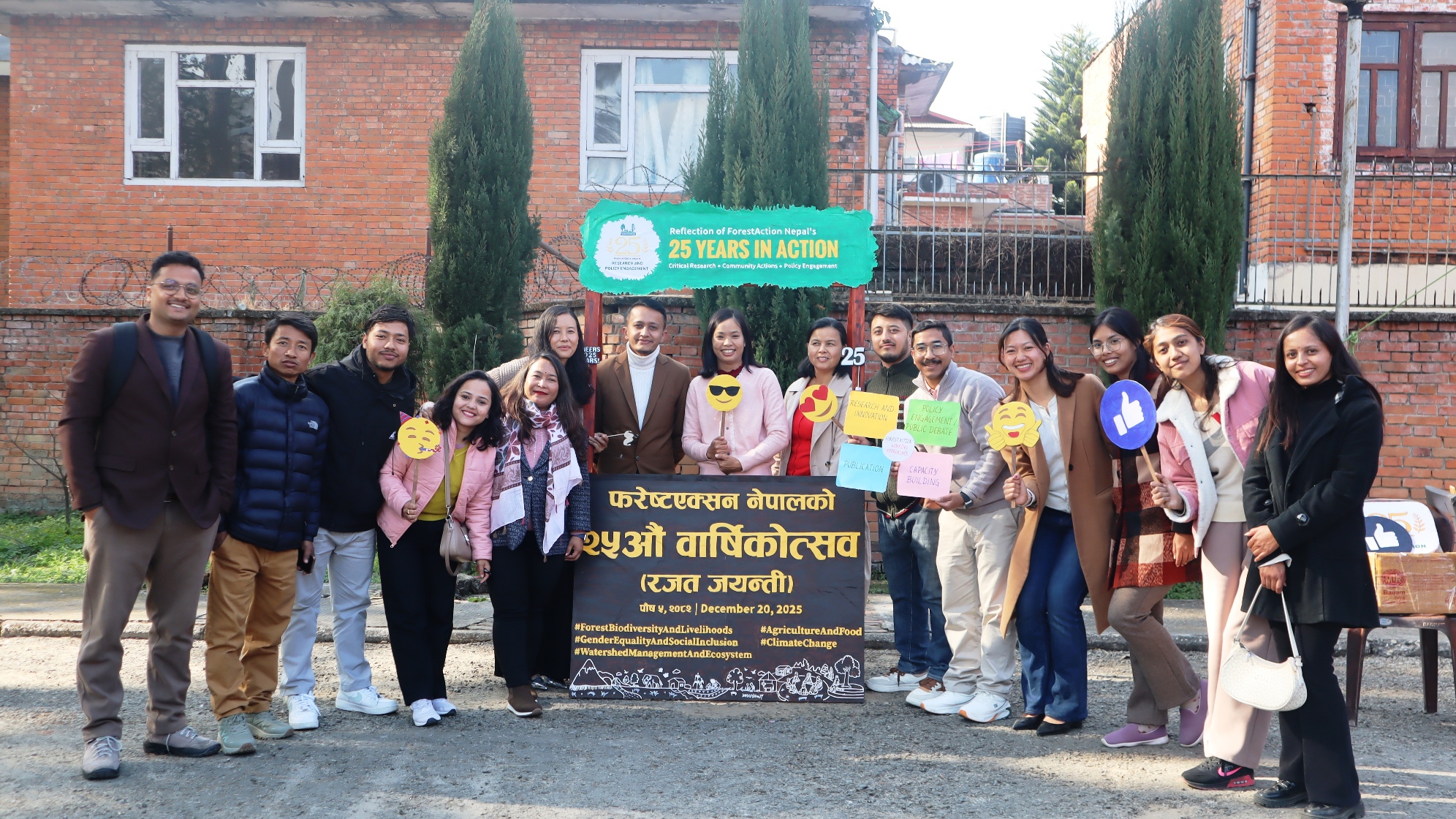
On 20th December 2025, ForestAction Nepal celebrated its Silver Jubilee, marking 25 years of research and policy engagement in forests, agriculture and natural resource management. The Minister of Forests and Environment attended as the Chief Guest of the event along with other delegates from environment, agriculture, research, policy sectors and development partners.
The highlight of the celebration was the inauguration of ForestAction Nepal’s book consisting of 25 years of learnings and reflection in NRM and policy engagement. A critical panel discussion was held addressing the contemporary issues and practices of NRM and future strategies. The participants were also presented with displays of various publications. models of ecosystems and other engaging activities. The evening concluded with tasting of various local dishes, highlighting organic foods and farming.
फरेष्टएक्सन नेपालले वन, कृषि तथा समग्र प्राकृतिक स्रोत व्यवस्थापनका क्षेत्रमा अनुसन्धान र नीतिगत संलग्नतामा बिताएका गौरवमय २५ वर्षको अवसरमा रजत जयन्ती कार्यक्रम मिति २० डिसेम्बर २०२५ का दिन सफलतापूर्वक सम्पन्न गरेको छ।
उक्त कार्यक्रममा संघीय वन तथा वातावरण मन्त्री, बागमती प्रदेश सभाका उपसभामुख, राष्ट्रपति चुरे–तराई मधेश संरक्षण विकास समितिका अध्यक्ष, कृषि तथा पशुपन्छी विकास मन्त्रालयका सचिव, राष्ट्रिय योजना आयोगका पूर्व उपाध्यक्ष, पूर्व सांसद, पूर्व राजदूत, संघीय वन तथा कृषि मन्त्रालय अन्तर्गतका विभिन्न विभागका महानिर्देशकहरू, नेपाल, अमेरिका, बेलायत, अष्टे«लिया तथा क्यानडाका विश्वविद्यालय तथा अनुसन्धानमुलक संस्थाका प्राध्यापक, कुटनीतिज्ञ, तथा अनुसन्धान वैज्ञानिकहरू, सामुदायिक वन उपभोक्ता महासंघका अध्यक्ष तथा अन्य नागरिक समाज संस्थाका प्रमुख एवं प्रतिनिधिहरू, सामाजिक विषयवस्तुमा विशिष्टता हासिल गरेका शैक्षिक÷प्राज्ञिक व्यक्तित्वहरू, अनुसन्धानकर्ता तथा वरिष्ठ सञ्चारकर्मीहरूको उल्लेखनीय उपस्थिति रहेको थियो।
कार्यक्रमअन्तर्गत सहभागीहरूबीच Evidence–based participatory action research, सामुदायिक वन तथा समग्र प्राकृतिक स्रोत व्यवस्थापनका क्षेत्रमा भएका प्रयासहरू र भावी रणनीतिहरूका विषयमा गहन चिन्तन तथा आलोचनात्मक बहस गरिएको थियो। साथै, फरेष्टएक्सन नेपालको २५ वर्षे यात्राका सिकाइ र आत्ममन्थन समेटिएको पुस्तकको लोकार्पण, विभिन्न प्रकाशनहरूको प्रदर्शनी, प्राकृतिक स्रोत र कृषि प्रणालीका नमुनाहरूको अवलोकन, तथा जैविक खाद्य प्रवद्र्धनका लागि रैथाने परिकारको स्वादसहितको ‘रैथाने खाद्य साँझ’ कार्यक्रम आयोजना गरिएको थियो।
लोकार्पित पुस्तकबाट केही अंश– “हामीले परिकल्पना गरेका सबै लक्ष्य र उद्देश्यहरू पूर्ण रूपमा हासिल गर्न सकेका छैनौँ, न त सबै परियोजना तथा सरोकारवालाहरूका अपेक्षाहरू नै सम्पूर्ण रूपमा सम्बोधन गर्न सकेका छौँ। यद्यपि, हाम्रो इमानदार प्रयासमा कहिल्यै सम्झौता गरेका छैनौँ। अपेक्षित उपलब्धिहरूप्रति पूर्ण सन्तुष्टि नभए तापनि, संस्थागत रूपमा भएका सामूहिक प्रयास र संघर्षलाई खुलेर प्रशंसा गर्दै हामी गर्व महसुस गर्दछौँ।”
“संस्थाले अंगिकार गरेको सामूहिक र Horizontal नेतृत्व अभ्यासका कारण यस यात्राक्रममा फरेष्टएक्सन नेपालले नेतृत्व संकट बेहोर्नुपरेन। यस प्रक्रियाले युवावर्गलाई समेत नेतृत्वका लागि तयार पार्दै निरन्तर नेतृत्व विकास सम्भव बनाएको छ।”
“वर्तमान सन्दर्भमा प्रतिनिधित्व र जवाफदेहिताको संकटले नीति निर्माताहरू र नागरिकहरूबीच व्यापक अविश्वास र निराशा सिर्जना गरेको छ। यस्तो अवस्थामा नीति बहसमा आलोचनात्मक अनुसन्धान तथा बहु–सरोकारवाला प्रक्रियाको भूमिका झन् महत्वपूर्ण बन्दै गएको छ। परम्परागत नीति निर्माण प्रक्रियालाई विज्ञानसम्मत, प्रमाणमा आधारित र जनस्तरसँग जोड्ने विधिको विकासका लागि हाम्रा अनुसन्धान तथा सञ्चार रणनीतिहरूलाई अझ विश्वसनीय र सुदृढ बनाउनु आवश्यक छ। यस अवधिमा हामीले सिकेका छौँ कि फरक रणनीतिहरू फरक सन्दर्भ र फरक नीति एजेन्डाका लागि उपयोगी हुन्छन्। यद्यपि केही रणनीतिहरू विशिष्ट सन्दर्भमा अरूभन्दा बढी प्राथमिकतामा पर्न सक्छन्, हामी कुनै पनि रणनीतिलाई पूर्ण रूपमा अस्वीकार गर्न सक्दैनौँ। जुनसुकै रणनीति अपनाइए पनि, बलियो अनुसन्धान पद्धतिमार्फत नयाँ प्रमाणहरू सिर्जना गर्नु र संस्थागत विश्वसनीयता कायम राख्नु फरेष्टएक्सन नेपालको प्रमुख प्रतिबद्धता रहँदै आएको छ।”
Better Chitwan organised the third series of “The Chitwan Kachahari – Festival of Ideas” from December 11–13, 2025, at Narayani Kala Mandir, Chitwan. ForestAction Nepal, serving as the Secretariat of the Alliance of Agriculture for Food, was one of the co-organisers and hosted a session titled “Agroecological Farming: Not an Alternative, but the Mainstream.” The session featured a drama performance, a thematic song, and a panel discussion.
The session began with a drama titled “Astitwa” (Existence) presented by students of Lamjung Agriculture Campus. With the Earth positioned as the central character, the play unfolded through imagined dialogues between humans and different planets, vividly portraying the environmental crisis confronting our planet. The performance highlighted the suffering of the Earth, the struggles and constraints faced by farmers, and the imbalances in our food system, ultimately delivering a powerful call to protect nature and restore harmony between humanity and the Earth.
The drama was followed by a song titled “Kohi Murkha Kina Yaha Kheti Garos” (“Why Would a Fool Farm Here?”), which not only presented a satirical portrayal of the current agricultural scenario and society perspective but also raised critical questions about the challenges of farming and the importance of agriculture.
Following the performances, a panel discussion on “Agroecological Farming: Not an Alternative, but the Mainstream” was conducted. The panel included natural farming practitioners and activists Chhabilal Neupane and Rashmi Pandit, and was moderated by agriculture student Pari Bikram.
Speaking on the panel, Rashmi Pandit emphasised that natural farming is a sustainable, soil and environment centred agricultural enterprise and should be advanced as a mainstream practice rather than an alternative. Similarly, Chhabilal Neupane noted that reliance on chemical pesticides and imported fertilisers makes agriculture costly over time, while natural farming reduces production costs and conserves soil health through the use of on-farm compost, beneficial microorganisms, and natural pesticides.
Activist Sujata Tamang emphasised that future farmers are today’s youth and highlighted the need for early education that connects children with soil and farming, from the audience. Additionally, Uddhav Adhikari, Coordinator of the Alliance of Agriculture for Food, warned that chemical fertiliser and pesticides based conventional farming and unsustainable consumption threaten human civilisation and urged greater commitment to protecting soil, nature, and life through poetry.
Alongside the discussion sessions, various exhibition stalls were set up at the venue, showcasing informative posters and artwork related to food systems, alternative agriculture, and soil conservation, enriching the overall learning experience of the event.
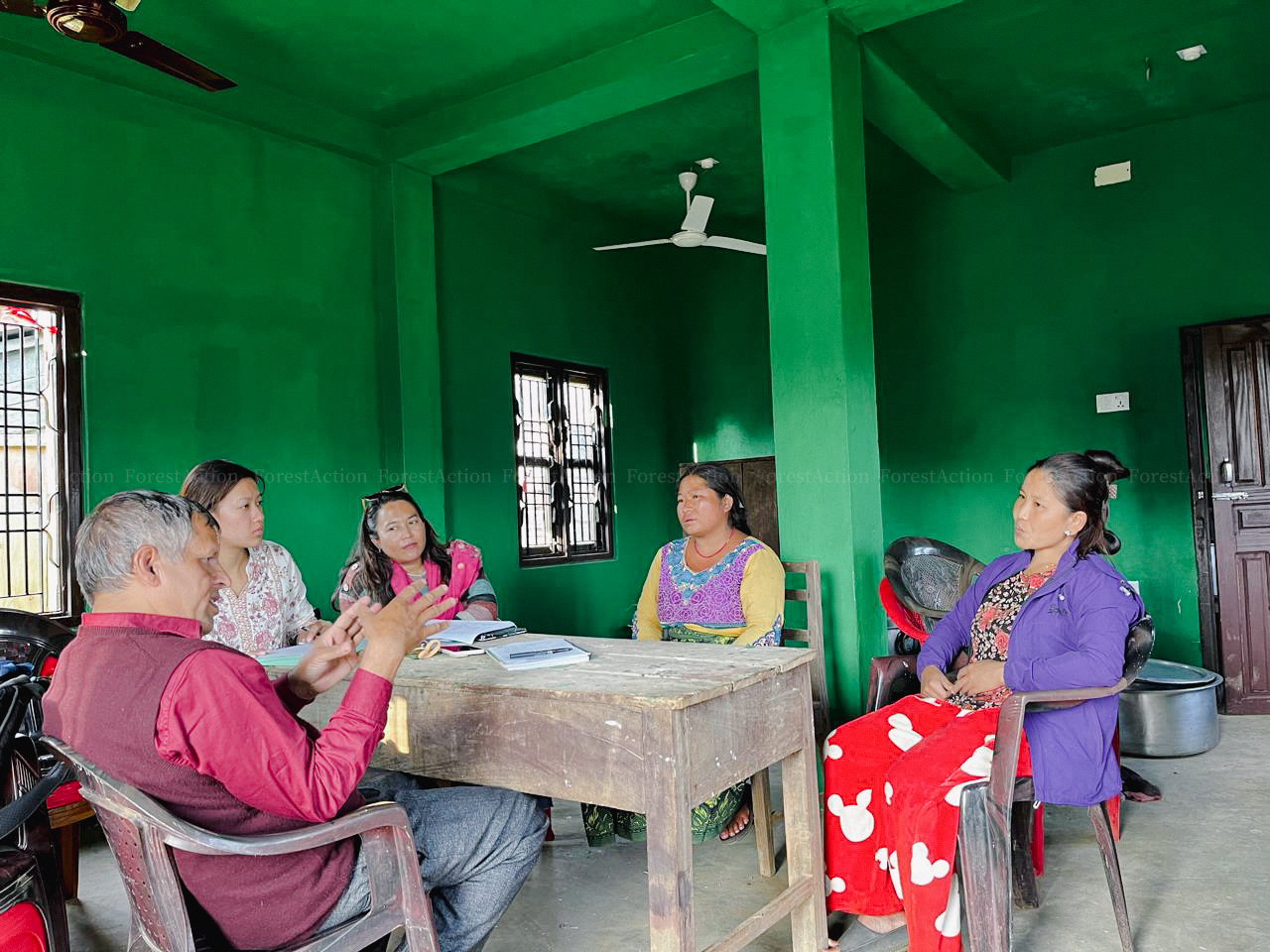
As part of the Building Agroforestry-based Adaptation Plans for Resilient Floodplains (BAGAR) Project, ForestAction Nepal conducted a field study in Marin Rural Municipality, Sindhuli District, from 12–19 October 2025 to support the development of a municipality-level Agroforestry Guideline. The field engagement involved Focus Group Discussions and Key Informant Interviews across all wards, bringing together farmers, agroforestry practitioners, municipal representatives, and ward-level stakeholders. These interactions focused on understanding local livelihood systems, agroforestry practices, climate-related challenges, and institutional perspectives to inform locally appropriate planning.
Following the qualitative consultations, a household survey was carried out from 1–8 December 2025 across the municipality using representative sampling to triangulate information and strengthen the evidence base. Structured questionnaires captured data on land use, landholding patterns, crop–tree combinations, income sources, agroforestry management practices, and challenges. The combined insights from field discussions and household surveys are being used to inform the preparation of a context-specific, inclusive, and climate-resilient agroforestry guideline that reflects local conditions and priorities in Marin Rural Municipality.
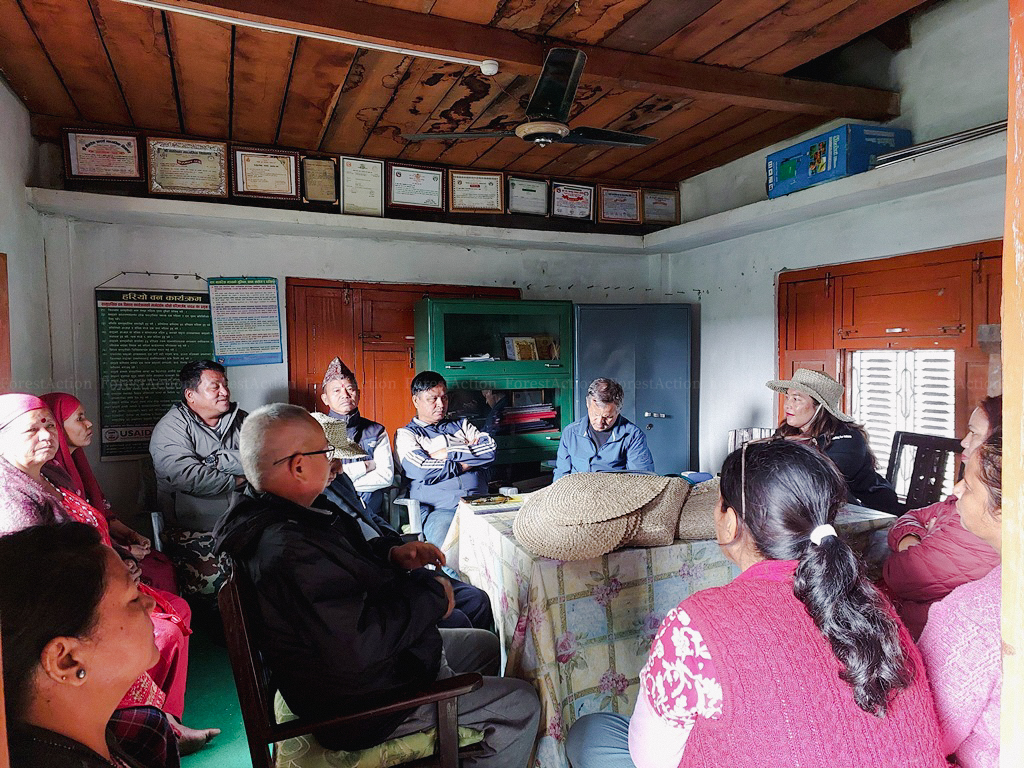
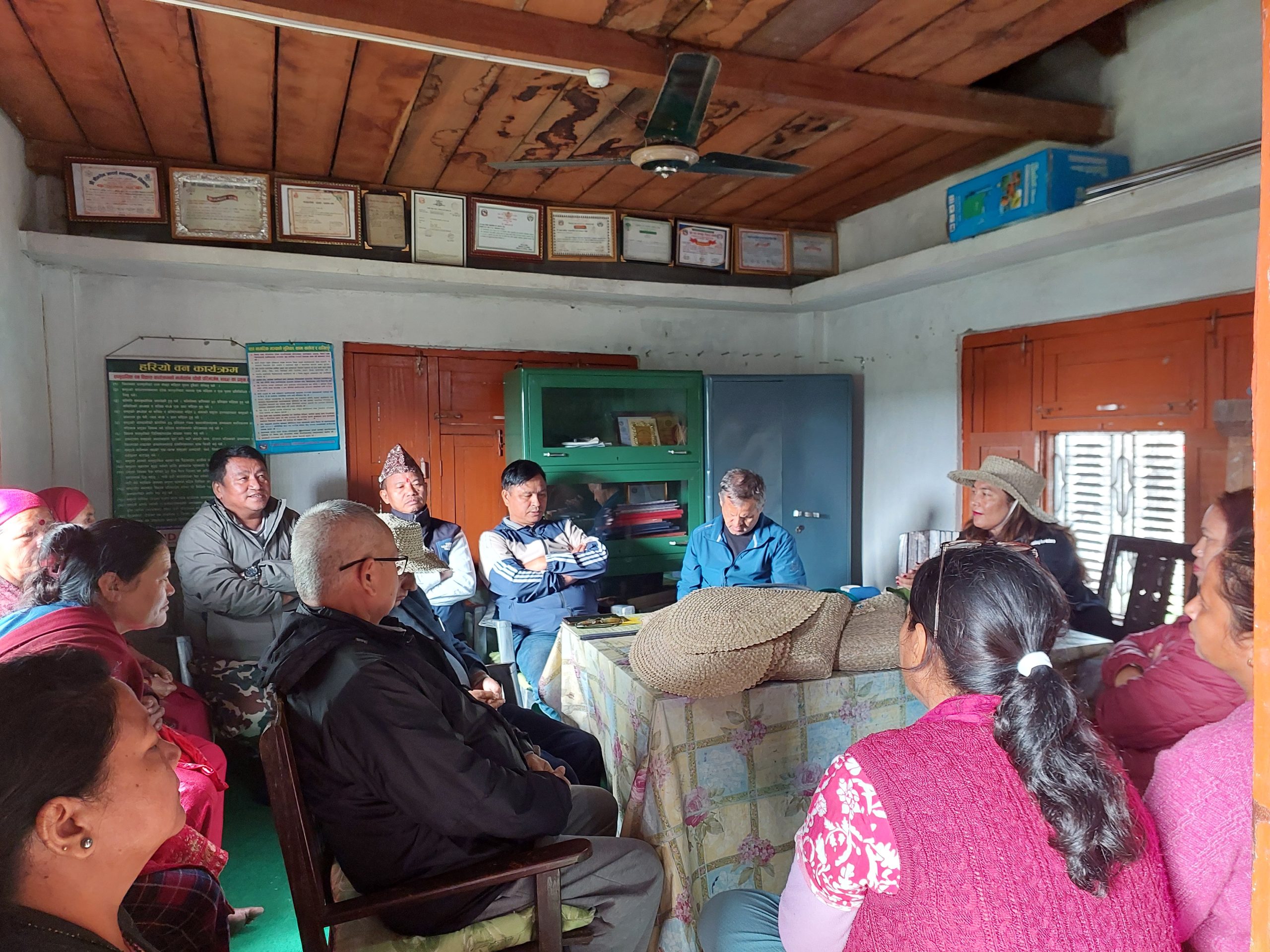
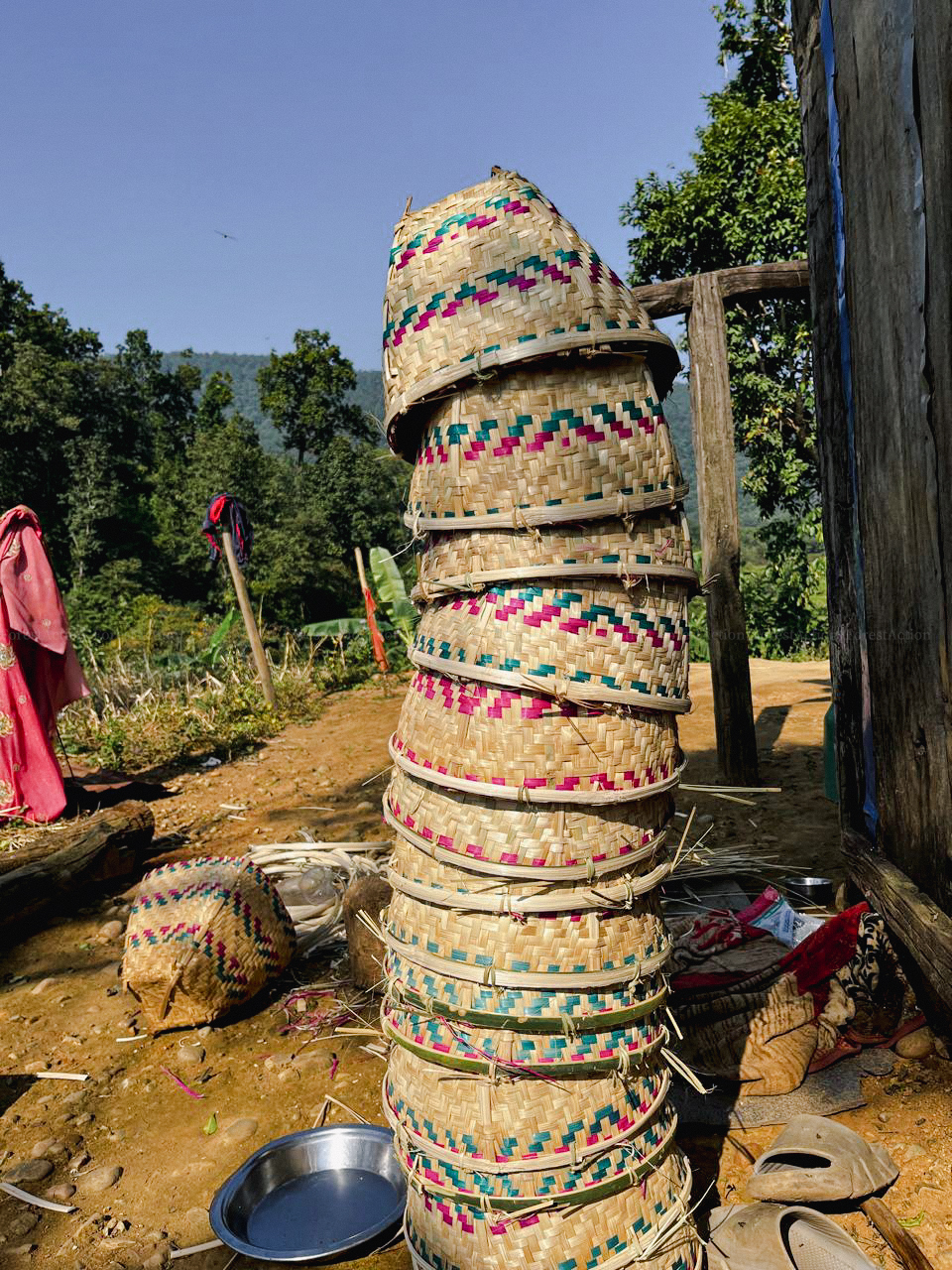
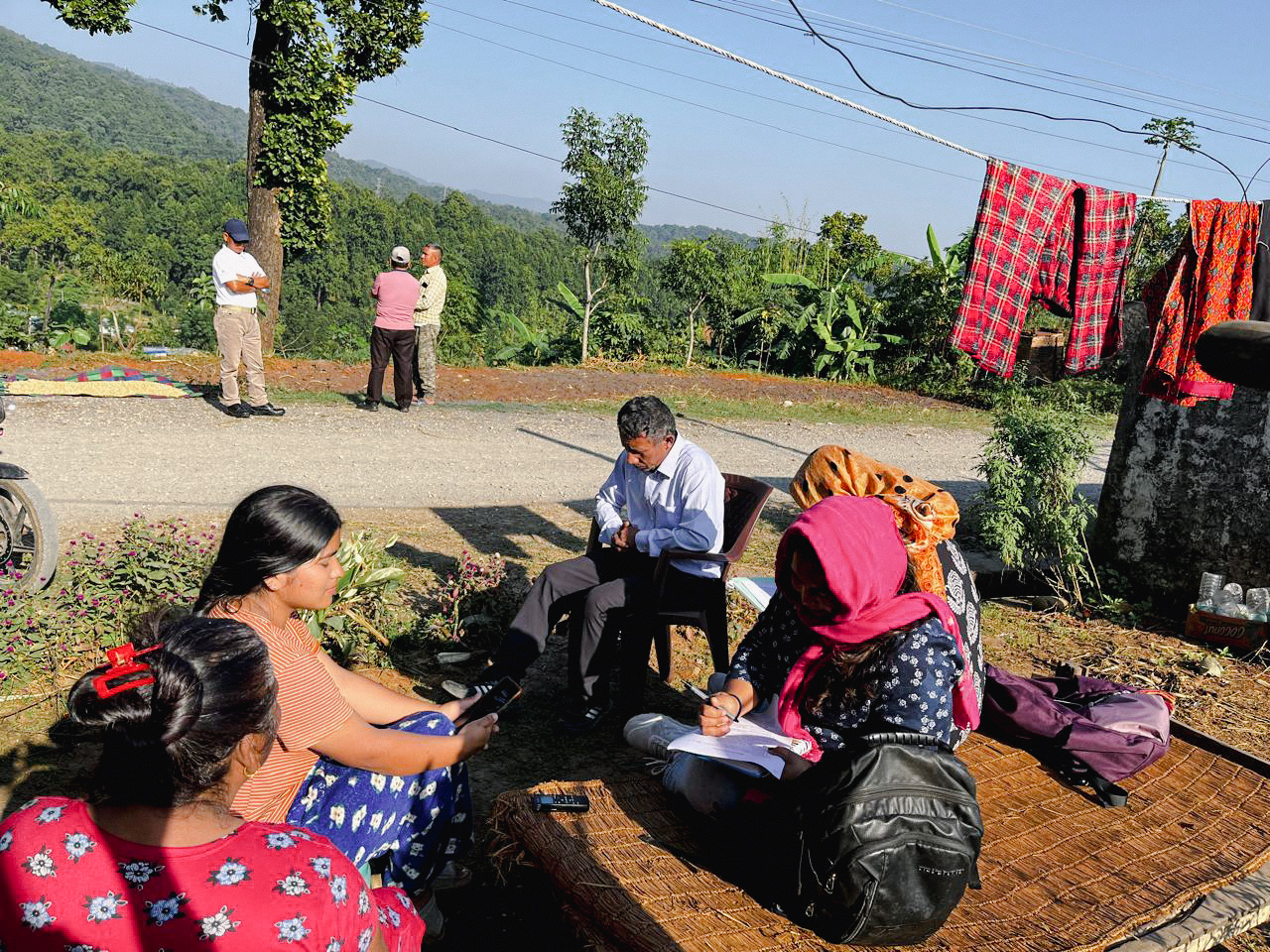
In the present changing context, climate finance has emerged as a crucial aspect to support mitigation and adaptation actions to address climate change. Noting this, ForestAction Nepal is currently implementing Climate Action Financing through Women and Social Enterprise (CAFIN) project, an International Development Research Centre (IDRC) funded initiative through Climate Policy Initiative (CPI). As a part of this project, the team visited women led enterprises of Gaidakot and Devachuli Rural Municipalities of Nawalpur district from 12th November till 15th November.
The team had visited these enterprises three years after their establishment to observe their sustainability and explore challenges and opportunities in terms of integrating climate financing to support their present and future interventions. Altogether eight enterprises of Duna Tapari, Thakal, Bamboo, Triphala, etc were visited; four in Gaidakot and four in Devachuli Rural Municipalities. Focused group discussions and interviews were conducted with women entrepreneurs to gain insights of their productivity, motivation, finance along with issues and future pathways for the enterprises. Similarly, meetings were held with the local government stakeholders (mayors, ward chairpersons) of the municipalities to discuss broader market environment, existing constraints, and potential strategies to expand the reach and visibility of enterprise products to wider audiences. FAN team also facilitated discussion with financial institutions (banks, cooperatives) to explore their knowledge in regards to climate change and financing, and to examine their policies and potential roles in supporting and sustaining women-led enterprises.
ForestAction Nepal, the secretariat of the Alliance of Agriculture for Food (AAF), in collaboration with the Association of Nepali Agricultural Journalists (ANAJ), organized a press meet on 21st April, 2025 at SAP-Falcha, Babarmahal to officially inaugurate the month-long journey “जैविक कृषि जागरण यात्रा”, scheduled from 22nd April to 21st May. During this event, a press note was also released in the presence of journalists, activists, and farmers.
Over a month, this journey will cover the locations across Bagamati Province, Madhesh Province, and Koshi Province. Along the way, the team will engage in dialogue, interactive sessions, observation, and experience sharing with farmers, local communities, students, Local Government, and Provincial Government. The journey focuses on raising awareness and facilitating discussion on issues such as the impacts of excessive use of chemical fertilizers and pesticides, soil degradation, loss of biodiversity, public health risks, water crisis, and climate crisis.
ForestAction Nepal has been actively engaging in policy research and advocacy focused on agroecology and sustainable food system. ForestAction Nepal, the secretariat of the Alliance of Agriculture for Food (AAF), critically reviews the policy processes and content related to agricultural development in Nepal and offering feedback and inputs derived from reviews, field actions, policy forums and interactions to orient it towards agroecology.
On 2nd April 2025, ForestAction Nepal organised a half-day interactive program in Kathmandu to discuss the draft of National Agricultural Policy 2081 which is currently under review in the parliamentary committee. The program was held in the presence of Honorable members of the Agriculture, Cooperative, and Natural Resources Committee, government officials, civil society actors, farmers, activists, media personnel, and students.
During the program, Dr. Krishna Prasad Poudel, a policy analyst and an agricultural activist, representing AAF delivered a presentation highlighting the key changes to be made in the policy draft. He mentioned that policy must incorporate farmers’ friendly sustainable agricultural practices that suit our geography, environment, and culture, to address future food security challenges. He also expressed frustration over the delayed policy formation, highlighting that plans for a new agricultural policy began in 2077 BS but remained incomplete even in 2081 BS.
Dr. Ram Krishna Shrestha, Joint Secretary at the Ministry of Agriculture and Livestock Development, highlighted challenges in balancing soil conservation, sustainable farming, and agricultural productivity. He guaranteed that the goal of the policy is to promote sustainable agriculture while gradually decreasing the use of chemical fertilizers and pesticides.
Honorable members of the Agriculture, Cooperative, and Natural Resources Committee expressed their commitment to addressing the issues discussed in the program and would be included in future meetings of the Committee.
The discussion highlighted several concerns including the lack of adequate provisions for climate change adaptation, land management, agricultural education, and protection of small and women farmers which were raised by activists and farmer organisations.
The team also submitted written feedback to the Agriculture, Cooperative, and Natural Resources Committee for incorporation while finalising the policy. Click here for written feedback
Old growth forest along with Pokhari and temple in Satyawati religious forest in Palpa district
Background
Deep inside the forest, under the canopy of old growth trees, we can feel the whispering winds of ancient forests and hear the soothing forest acoustics. Beneath our feet, tangled roots of ancient trees in long-established ecosystem communicate through a massive network of fungal hyphae. The tree trunk composed of hundreds of concentric rings inscribe a history of details of climate spanning centuries. Each ring tells the story of how the land was wounded, how it healed, and how life responded to changing climate and human perturbation. Unfortunately, such old growth forests are rarely found in the domesticated landscape we live today. Here we tell a story where old growth trees and forests are preserved and the practice that protects these heritages.
Today, as we stand at the crossroads of environmental degradation and ecological restoration, it’s time to contemplate on memories of the land and its forests that have shaped our cultures and lives for centuries. At the same time, we also need to retrospect how humanity has destroyed, altered and degraded the shared home of millions of species.
Reflecting on the past, there was a serious concern about widespread environmental degradation in the southern flanks of the Himalayas during 1970s. Erik Eckholm’s narratives in his book “Losing Ground” laid the foundation for the ‘Theory of Himalayan Degradation’. He attributed unsustainable agricultural practices, poverty and growing population in the hills as cause of deforestation, soil erosion, landslide and flood.
Later, scholars scrutinized the theory and presented counter narratives and argued that the theory oversimplified the complex socio-ecological problems. TBS Mahat through in-depth cases in Sindhupalchowk highlighted that deforestation in the middle hills of Nepal was not a sudden phenomenon of 1950s, but a long-standing process dating back to the late 18th century. Scholars presented that environmental degradation including deforestation was the result of government policies prioritizing agricultural land and promoting unsustainable land use for revenue generation.
Amidst the debate on widespread of deforestation and forest degradation there also remained a spark of hope; like seeds of life in the ashes. Scholars have presented cases where communities have conserved forests and natural heritages through social norms, belief systems and cultural practices. Sacred groves, ancient trees, communal spaces like Chautaris (a traditional resting place), and water sources continue to flourish. These spaces, nurtured by centuries old traditions, stand as a beacon of hope for restoration in the era of environmental crises.
Sacred groves: a place of worship or conservation?
An old growth forest surrounds the Rambhadevi temple, a popular shrine in Palpa district. While the surrounding landscape has lost its old growth trees, these remain protected around the temple. Generally referred as Rambhapani, this sacred site is closely linked to water protection. According to locals, Lord Ram is believed to have created a spring just above the temple during his visit. This belief has played a role in forest protection. Additionally, historical records show that the Rana rulers issued a Lalmohar (an order) in 1918 BS to protect the forest, ensuring its survival for generations. Today, Rambhadevi Forest is home to 35 native tree species, including massive old-growth trees like Kaulo and Saur, old Bet liana stretching over 100 meters, and diverse wildlife, including notable abundance of squirrels.
A small island of trees stands in the crop field and settlement near the bank of Narayani River in Gaindakot. This grove called Mahadevthan was protected by the Tharu people as a place for their deity. It survived the wave of deforestation in Terai during the 1950s to 1970s. This grove, less than two ha, is home to 38 native species of trees including several old-growth individuals, most of which have naturally regenerated. Similarly, in a nearby locality, a sacred grove called Devithan was observed to host a remarkable 20-meter-tall Bakhre ghans (Streblus asper) tree with over 60 cm diameter at breast height. No such large tree of this species is found in the landscape.
Small grove that survived the wave of deforestation in Terai Nepal (Mahadevthan in Gaindakot 13)
Our observation in Pokharichhap village, Ghiring, Tanahun, showed that tall Simal trees serve as critical nesting and resting sites for white-rumped vultures. The grove itself is considered sacred, with several thans (places of worship) established within it, reinforcing its role in conservation through cultural reverence.
In Chaubas of Kavre one can commonly see pine forests which were established in the degraded areas. In the mosaics of pine forest and farm, there exists a distinct grove of broad-leaved trees. Actually, the grove was a sacred site known as Kali Devi or Devithan. The grove has old growth trees of Aanp, Mauwa, Chilaune, Banj, Phalant and others. One of the local female residing there explained that people believed cutting trees or polluting the Devithan area will displease the goddess. Not only in Chaubas, but also across the country, people worship and protect trees to keep bad spirit away.
These sacred sites not only conserve ancient trees but also provide refuge and protect biodiversity during times of environmental distress. It became clear that local communities conserve forests through a mix of belief systems, cultural practices and a sense of environmental responsibility. Though not always framed in terms of biodiversity, their efforts are crucial for forest conservation. Cases of biodiversity of various sacred groves clearly show that they are not only a place for worship but also have high conservation values as both of them co-exist.
Satyawati religious forest with an old growth tree of Tooni
What legacy do we leave for future generations?
While walking alongside planted pine forest at Chaubas, we stopped at an abandoned Chautari, which had an old growth tree of Lankuri, measuring 98 cm diameter at breast height. No such big trees were seen in the landscape. We did not see Lankuri trees in the pine forest either, that was planted four decades ago.
Then, we came across Pale Ban, an ancient forest protected by the local community for generations. Strict regulations prevent tree cutting, protecting and conserving native species like Sano Aarpate, Kafal, Jhigane, Gurans, and Lapsi. The forest is protected as it shelters Padhera, a natural spring, and locals have long known that cutting trees near water sources causes depletion of natural springs. In the landscape dominated by pine plantations mostly coming all the way from Mexico, these old native trees remain conserved due to cultural beliefs and social rules.
The legacy we leave, as shown by the Chautari and pale ban in Chaubas, the groves in Gaindakot, Rambhadevi and Satyawati is our commitment to conserve both nature and culture. This imparts a powerful reminder that the decisions and contributions we make today to conserve natural environment are the legacy we leave for tomorrow.
Gods and goddesses dwell where trees thrive and waters flow
Near Pokharichap village in Ghiring, Tanahun, there is a pandhero (water spring) from where people used to fetch drinking water. While tap water is now available in the village, four springs are designated for human use, and two remain reserved for livestock. Yogendra Bikram Poudel, who has expertise on differentiating plant species, walked around the spring to count and identify trees. He recorded nearly 50 individual trees from 30 different species around the water spring, including several tall and old tree. Among them, Dhalne Katus and Simal stand out, with some trees exceeding 100 cm in diameter-larger than those found in the nearby community forest. The grove also harbors rare species of trees like Gai Simal, adding to the area’s biodiversity value.
Rich grove along with Pandhero (Kuwa) in Ghiring
It is believed that Satyawati Bajai, resides in the Satyawati Religious Forest in Palpa. For generations, the local Magar community driven by belief in the supernatural power of bajai has protected the area, ensuring its conservation. The forest is home to around 75 species of trees. Sadan, Chilaune, Tooni, and Mauwa trees dominate the forest. The forest hosts vulnerable species listed on the IUCN Red List, such as Satisal, along with medicinal plants like Ayero, Harro, Barro, and Hadchur. It also hosts rare species like Kukhure Kath and sacred plants such as Belpatra and Rajbriskha. The forest is home to hundreds of birds like Jureli, Nyauli, and Kaliz, and animals such as Mriga and Ban Biralo.
Beside the temple of bajai lies Satyawati Lake which is more than just a water body. Pilgrims circle the lake three times shouting their wishes to a bajai believed to be hard of hearing but immensely powerful. Rituals like taking a holy bath and placing linga (Bamboo, Sal stems) in the lake symbolize devotion, with a belief tied to the water; placing more linga, makes the lake grow, strengthening the goddess and fulfilling wishes. Scientifically, displaced water creates the illusion of lake growing, linking tradition with nature. This belief draws thousands of devotees, helping protect the lake and its surrounding forest.
As we ventured further in Satyawati, we discovered Dyangtung Kuwa, a water source surrounded by ancient trees of Khalluk and Chilaune. In fact, there are more than six such kuwas scattered across the religious and community forests nearby. Isn’t it remarkable how belief in bajai helped preserve forest and the vital water resources, ensuring they don’t vanish?
When roots weaken and guardians fall
Sacred groves and all landscape legacies are facing numerous threats that compromise their bo th cultural and ecological integrity. Mismanagement of financial resources coupled with misguided concept about ‘development’ have hampered conservation of both cultural and natural heritages in sacred sites and forests. Recently, the government has increased funds for sacred sites under the rubric of tourism promotion. Such funds have promoted construction of cemented structures, hindering the natural history of such sites. For example, in Gaindakot, funds have been used to build concrete structures and pave floors with mosaic tiles, hindering tree regeneration and altering the natural ecosystem within the grove.
Fragmentation poses another major challenge in conservation of sacred forests. Ramdhuni, a sacred forest in Sunsari district, is a remnant of once a continuous charkoshe forest. The patch of forest somehow survived deforestation and still holds a diversity of trees composed of giants and old-grown ones. The hardly survived patch has now been severed by high-tension power lines and roads, further fragmenting forest which was already isolated. This fragmentation has created more edge areas, which are more susceptible to disturbance and invasion by non-native species. In turn, species like Mikania, Chromolaena, Lantana etc. have invaded the forest impacting its resilience.
Ramdhuni forest, a remnant forest in sunsari district, traversed by transmission line
Satyawati Religious forest features several old growth trees but the uncommon species in the forest, Tejpaat, has begun to encroach in recent years. Birds have brought Tejpaat seeds from nearby plantations. Simultaneously, moist soil and shade of trees around the lake provides a perfect cradle for its rapid growth. But this new plant comes at an irreversible ecological cost- its rapid growth potentially hinders regeneration of native trees. There may be several mechanisms by which Tejpaat outcompete residential trees. What happens when the old trees fall and no saplings rise to take their place? The tale of Satyawati Bajai is deeply rooted in her journey from Thulo Lhungpek, a barren land, to the lake she now blesses. But if the forest dwindles and the balance breaks, will she abandon the land she once transformed into a sanctuary? Should we let the legacy of Satyawati fall along with those old growth trees? This is the challenge that we, the stewards of tomorrow, must confront.
Learning from legacies and shaping restoration
Several cases of holy sites, sacred trees, water springs, and other cultural elements from various regions of the country, representing diverse communities, clearly show how social norms, belief systems, and cultural practices have played a significant key role in conserving biodiversity. These practices have been particularly effective in retaining the old-growth features of forests, these features are often lost in intensively managed and secondary forests. Indeed, this illustrates an effective and truly community-based model of conservation practiced by local and indigenous people.
Old growth trees in sacred sites, Mahavethan and Devisthan in Gaindakot respectively
Sacred groves shelter ancient trees, offering refuge to birds and wildlife, and supporting rich biodiversity. Ancient trees indeed are a memory of forgotten ecosystem. They function as natural water reservoirs, protecting springs and streams, while their dense canopies help regulate microclimates and maintain soil health. Old-growth trees provide several habitats within their branches and bark, creating small homes, known as microhabitats, for many animals. Sacred groves and standing old trees also serve as stepping stone and resting places for birds and animals moving through landscape. Tree rings preserved in old growth trees carry data on past land use, climate and disturbances.
Trees in sacred groves and sites are of paramount significance to design forest landscape restoration. The restoration in turn starts with looking back in the history to get idea about the past vegetation of the landscape. These trees provide insights into the historical vegetation of the landscape, which is essential for designing restoration projects and determining their long-term trajectories. They serve as a vital source of seeds or propagules for forest landscape restoration. However, our restoration efforts have often failed to capitalize and learn from these legacies of landscape, as evidenced by our walk through the restored forest of Chaubas, where we observed the absence of native trees in the newly restored forests.
Sacred sites hold deep cultural and ecological significance, yet their biodiversity value, the beliefs system, social norms, cultural practices and customary institutions that protect them often go unrecognized. Lack of recognition of these sites and systems, make them vulnerable to encroachment and environmental changes.
Sacred groves and old growth trees woven into human settlements stand as living bridges between culture and nature, safeguarding biodiversity while carrying the legacies of past vegetation and land use for generations. More than sanctuaries of conservation, they whisper the pathways of renewal, guiding us toward forest landscape restoration and the revival of disrupted ecological harmony. So, to the generations yet to come, we will cherish the monumental and old-growth trees, the groves, the water springs, the birds, the animals and the spirits of the land, for they are not just our past but our hope of restoration. Hope is not just a wish but the action we take in conserving what we inherited, for generations to come.
Aryal and Sharma are based in FECOFUN and ForestAction Nepal, respectively and working in Reversing Environmental Degradation in Asia and Africa (REDAA) project. REDAA is funded by UK International Development from the UK’s Foreign, Commonwealth and Development Office (FCDO) and managed by International Institute for Environment and Development (IIED).
ForestAction Nepal recently conducted “Fire-Responsive Forest Management Trainings” for community forest user group members. ForestAction Nepal in collaboration with the Australian Himalayan Foundation (AHF) is undertaking this initiative on ‘Fostering Community-Led Forest Fire Management in High-Altitude Regions of Nepal’ in Dolakha and Sindhupalchowk.
The training took place from 1st March and continued till 20th March 2025. Altogether four CFUGs were targeted: BanjheKapase, Bhedigoth, Golmeshwor, and Salleri in Sindhupalchowk and Dolakha districts. Both conceptual aspects and field based demonstrations on forest management were conducted in the respective community forests. A total of 84 community user groups participated in the training.
The training was helpful in:
– Understanding sustainable forest management practices in relation to forest fire management.
– Bridging traditional community forest management knowledge with scientific approaches and management techniques for more effective decision-making.
– Hands-on experience in fireline construction and maintenance.
– Discussions on “Nepal’s forest management legal framework” and community roles in fire prevention.
Empowering communities with knowledge and practical skills is key to proactive and sustainable forest fire management. This training is a step toward enhancing community resilience in forest fire management.
ForestAction Nepal’s agriculture team has recently completed their visit to Dhusa and Kalikhola, Ichhakamana Rural Municipality, where they are working with local farmers and the palika to promote agroecology. One of the approaches is field action research, where they are conducting trials and experiments to address the major challenges farmers face in their fields.
One of the significant challenge observed in both villages was the high reliance on chemical pesticides for pest management. To promote sustainable/agroecological practices and technologies, the team demonstrated the use of simple yet effective tools, yellow and blue sticky traps and Cue-Lure, to monitor and trap insect pest in cucumbers and beans, the major crops grown this season.
These tools weren’t new to the farmers, but they had been underutilised in managing insect pests in the fields. This intervention will be followed up with further support to ensure the effective use of these tools and continued learning for the farmers. By demonstrating the benefits of agroecological practices/technologies, we aim to boost farmers’ confidence in adopting these methods, leading to a gradual shift towards more sustainable farming practices.
Additionally, the preparation of an Effective Microorganism (EM) solution was demonstrated, and oriented to farmers about its uses and benefits. EM offers multiple benefits, including accelerating the decomposition of manure and increasing the population of beneficial microorganisms in the soil.
During this visit, the team also conducted a pilot survey with a few farmers to understand the factors influencing the adoption of organic and agroecological practices. The team further aims to reach at least 100 farmers from various parts of Nepal to explore these factors more comprehensively.
A training on the National Forest Information System (NFIS) and Safeguards Information System (SIS) system was organised by ForestAction (FA) Nepal in collaboration with REDD-IC and Upaveda Technology Pvt. Ltd., through financial support from the World Bank at FA office, Bagdol, Lalitpur. The training focused on equipping participants with the skills to collect and store essential data from 13 districts within the TAL project area. It was attended by 32 forest technicians, DFO staff, and REDD-IC personnel. The sessions primarily covered the functionalities of NFIS and SIS, data entry procedures, checklists, and quality assurance protocols.
The NFIS and SIS platforms in Nepal are web-based systems developed to manage, monitor, and share comprehensive forest-related data. Supported by the Forest Carbon Partnership Facility’s (FCPF) REDD Readiness Preparation Program, NFIS acts as a centralised database for Nepal’s forest information, supporting data-driven decision-making and effective forest management. It integrates various datasets, such as forest type maps, statistical analyses, and research reports, making crucial forest-related information accessible to stakeholders. The successful implementation of NFIS will contribute significantly to the advancement of Nepal’s forestry sector.
ForestAction Nepal’s agricultural team recently visited Ichhakamana Rural Municipality, where productive meetings were held with local farmers and farmer groups to explore opportunities for promoting agroecology, specifically focusing on soil restoration and biodiversity conservation. The team discussed the challenges faced by farmers, such as soil degradation and declining fertility, and how agroecological practices like crop rotation, organic farming, and agroforestry could address these issues. Emphasis was placed on restoring soil health through composting, mulching, and the use of bio-fertilizers, while also promoting biodiversity through intercropping and protecting pollinators.
The importance of a community-led approach to implementing these practices was highlighted, with farmer-led demonstration plots, training sessions, workshops, and capacity-building efforts identified as key strategies to strengthen local knowledge.
A significant outcome of the meeting was the agreement to develop a collaborative action plan, that ensures farmers are actively engaged at every stage, from planning and implementation to monitoring and evaluating progress.
Additionally, a meeting was held with the agriculture section of Ichhakamana Rural Municipality, where we provided an update on the discussions with the farmers’ groups, as we will be collaborating with the municipality in this initiative.
ForestAction Nepal has been actively promoting agroecology in Nepal through field action research, training and capacity-building activities, and policy advocacy, engaging stakeholders at the local, provincial, and federal levels. As part of these efforts, ForestAction Nepal has been utilizing public platforms to raise awareness of agroecological issues, draw the attention of policymakers, and foster dialogue.
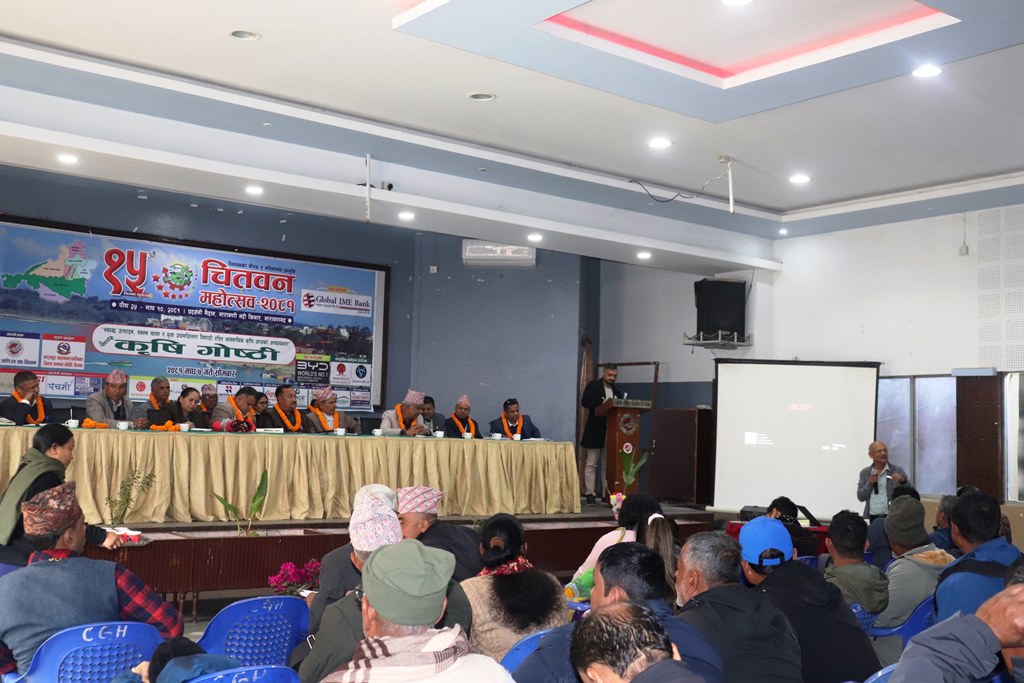
In this context, Dr. Krishna Prasad Paudel, representing ForestAction Nepal (the secretariat of the Alliance of Agriculture for Food), delivered a speech at the Agricultural Forum organized by the Chamber of Commerce and Industry (CCI) during the Chitwan Mahotsab on January 20, 2025. Dr. Paudel highlighted the consequences of chemical-based modern farming on soil fertility and human health and emphasized the urgent need to shift towards agroecological approaches.
Similarly, Mr. Chandra Prasad Adhikari, an organic farmer with over three decades of experience and president of the Organic Farmers Federation Chitwan, an ally of the Alliance of Agriculture for Food, provided valuable insights into the status and challenges of organic farming in Chitwan.
The forum was attended by the Honorable Prakash Shrestha, Minister of Agriculture and Livestock Development of Bagmati Province, as the Chief Guest. Other notable figures included Dr. Sharada Thapaliya, Vice-Chancellor of Agriculture and Forestry University; Mr. Narayan Prasad Adhikari, President of the Office of the District Coordination Committee Chitwan; Mr. Chun Narayan Shrestha, President of the Chamber of Commerce and Industry Chitwan; Mr. Jhalak Nath Kandel, Chief of the Agriculture Development Centre; and Mr. Sujan Amgain, Chief of the Beekeeping Development Program. More than 100 participants, including farmers, journalists, researchers, and stakeholders from diverse sectors, engaged in the discussions, which focused on current issues in the Nepalese agriculture sector and the need for collaboration among diverse stakeholders to advance sustainable agriculture in Nepal.